A Quick Guide to Freshers’ Finances

by Magical Penny on June 26, 2012

With students getting their results soon and preparing to head to university in the autumn they’ll need to look at their finances without delay

For many students, starting at university this year, will bring huge changes to their lives. Not only by living away from home for the first time, but also in learning to manage their own finances.

Student grants and loans are normally paid at the start of each term, and the temptation is strong to blow it all at the start of the year. Without careful planning they may need to visit sites like this one for extra cash. However, with some sensible budgeting they can ensure that, as students, they will be able to make their money last through the whole term.


Drawing up a simple chart showing the total amount of money the student will receive each term, and deducting from that a list of known expenditure will help enormously.


Rent for accommodation is often paid for each term in advance, and if public transport costs are incurred between accommodation and campus then a yearly season ticket is a sound idea and will save money over the whole academic year.

Once the essentials are pre-paid then the balance of the money available to the student can be divided between the number of weeks to be budgeted for, to give a weekly amount to cover food and household shopping, any clothing needed, and of course, those all-essential social activities which form part of student life at university.

Spending a little time in shopping for food and cooking meals is much more economical than eating out, and most supermarkets have special offers on different products each week. Many stores have free magazines which not only detail their offers, but also include recipes and handy seasonal hints, many of which are a real boon to those living away from home for the first time. Markets and discount stores also offer food at prices below those in supermarkets, so it is worth exploring what is available locally and taking advantage of those savings whilst they are there.

A handy way for students to limit their monthly expenditure is by using a pre-paid card, which are sometimes available with one of the many basic bank accounts on the market, by simply loading it with the sum allocated for that month and then using it to pay for everything during that time period. Pre-paid cards have some advantages over cash cards, particularly when it comes to budgeting, whilst some pre-paid cards come with bonus offers of cash-back rewards or worthwhile discounts on a range of products.


{ 1 comment }

Liability Insurance: Ensuring your SME is covered

by Magical Penny on June 12, 2012

Start up business costs can be a substantial investment. I’m currently in the process of setting up Magical Penny and my other web properties up as a business so I know (although a ‘web business’ is easier than many other kinds of businesses).

With any business births in the current climate, securing any element of your finances is a relief and peace of mind.

The British population has embraced the imported ‘claims culture’, putting small and medium enterprises under difficult financial pressures to perform perfectly without room for human error. From 2007 to 2011, the United Kingdom has seen an 18 per cent rise in liability claims, with 2010/11 recoveries totalling over a terrifying £10.6 million pounds.

The ‘claims culture’ is being nurtured by Claim Management Companies (CMCs) who make exorbitant amounts from successful cases. Their ‘no win, no fee’ policies attract exaggerated and fraudulent claims from individuals who are looking for a get rich quick opportunity, in between genuine cases of mistreatment and misfortune.

In 2011, a report from the Association of British Insurers alleged that 51 per cent of consumers had been contacted by CMCs in 2010 regarding potential injury or accident claims – a worrying statistic inferring that businesses need to be more vigilant than ever surrounding their potential public and professional liability.

Although not all liability insurance is legally required, taking out an inclusive policy should be considered as an investment for your business and not a hindrance. Whatever your business’s insurance needs, policies typically cover legal fees and compensation.

When you consider a professional indemnity insurance provider, or a trusted public or employer liability insurance company, you are taking steps to protect your enterprise from preventable economic failure.

Public Liability Insurance

Public liability insurance is not a compulsory insurance but it does cover your business against claims that surround any accident or injury caused by your company. This is not restricted to major health claims – public liability insurance ensures that clumsy damage to client’s property is also insured.

Public liability insurance is a basic, but reliable guarantee that should your business physically instigate an instance of damage or infirmity, your legal and liability costs are covered.

Employer Liability Insurance

Companies that employ any number of workers are legally required to take out employer liability insurance. This product protects employers and employees should any team members’ experience a work related accident or suffer from an illness induced by their occupation.

Although most moral small/medium enterprises (SME’s) have the interests of their workers in mind and implement comprehensive health and safety policies and procedures, it is always wise to prepare for unanticipated, unfortunate events.

Work related illnesses cause a high proportion of absence from work each year. The latest Health and Safety Executive key annual figures from 2010/11 confirm another astonishing year for industry induced sickness and injury. The fundamental figures affirm that approximately ‘1.2 million working people were suffering from a work-related illness’, while ‘171 workers were killed at work’ and ‘200,000 reportable injuries occurred’.

These dire demographics are unquestionably a warning sign for all organisations, but particularly SMEs. To put your business under avoidable fiscal jeopardy suggests complete discount towards the current climate.

Whether you employ individuals under a permanent or temporary basis you are required to take out a minimum policy cover of £5 million. You must also account for voluntary staff, or anyone who has performed tasks or chores to assist your business.

cautionProfessional Indemnity Insurance

Though every business insurance policy should be tailored to suit your line of work and individual business, it is imperative that you speak directly with your professional indemnity insurance provider to arrange suitable cover for your company.

Professional indemnity insurance is a far more complex form of insurance provided to protect those who run specialist businesses. If the service you provide your clients requires expert knowledge or professionally qualified acumen, you may find that you have had to take out professional indemnity insurance before you begin business.

This is particularly applicable to solicitors and architects, for example. Sale of your intellectual property, advice or creativity based services should be protected by professional indemnity insurance. Be sure that your intangible products are protected to the same level as material commodities.

Should a claim ascend surrounding negligence, copyright infringement, damage or loss of professional data, dishonesty or defamation, professional indemnity insurance will cover your legal fees in addition to any compensation costs, as ordered.


At a time when jobs at an all-time low and the recession is affecting all individuals from every walk of life, do not endanger your business. Consider taking out satisfactory insurance to protect your SME and survive the excessive ‘claim culture’ within the current economic climate.

{ 0 comments }

First Time Home Buyer’s Guide

by Magical Penny on June 8, 2012

With prices ever-increasing and interest rates on savings so low, setting foot on the property ladder seems an impossible dream for many people.

If you’ve been reading Magical Penny for a while you’ll know that as a single 20 something I’m very happy renting at this time in my life but if you’re in a different situation it may be heartbreaking to spend a significant chunk of a house deposit on a year’s rent and young families can struggle to find a house they can afford that has a garden for their children.


How does anyone manage to buy their first home?

For the younger generation, relying on their parents is one way of managing to fund a deposit. Certainly that’s how many of my friends have started on the housing ladder.

Parents who can afford to are loaning or giving their children large sums of money in lieu of an inheritance to help them buy their first house. Others are letting their grown-up children move back into the family home so that they can save up for a deposit.

Another option is buying with friends or a partner as this reduces the costs as each person can contribute to the deposit and monthly mortgage payments.


Otherwise, the only real option is to start saving as much as possible, as soon as possible. If you’re struggling to save consistently you should have a read of some of the many articles about saving money, here on Magical Penny


If you are looking at mortgages for buying a home you have a few options:

Understanding mortgages:

The most common mortgage is a repayment mortgage. Each month you pay back a portion of the amount borrowed, plus the interest for that month. At the end of the term you will have cleared your debt.

With an interest only mortgage, you only pay back the interest owed and at the end of the term, you are required to pay back the outstanding mortgage.


Rates and requirements:

Fixed rate mortgages offer interest which is unchanging throughout the period. If the interest rate drops, you will still be paying the higher rate.

With a variable mortgage, the interest rate will change as often as interest rates do, usually once a year.

As with all mortgages, if you do not keep up with your mortgage repayments, your home may be repossessed.


Tips for buying a home:

  • Write down your priorities – local schools, transport links, crime rate etc.
  • Work out how much you can afford as a deposit
  • Find out how much you can sensibly borrow
  • Decide how much you can afford to repay each month
  • Don’t forget the associated costs such as stamp duty, surveyors, solicitors etc.
  • Consider how much needs doing to the property – can you afford a new kitchen/roof etc.


{ 1 comment }

Four Ways To Make Sure You Get The Best Loan

by Magical Penny on May 31, 2012

From personal loans to mortgages, everyone wants to find the best deal.

Saving for what you want is the best way but if you do need to borrow money there is no reason to pay excessively to borrow money.

A smart consumer takes the time to shop around and look for the best opportunity. Starting your search at moneysupermarket.com can help, along with these tips for finding the best loan.


Look Closely at the Interest Rate

Just because one lender offers a lower APR (annual percentage rate), it does not mean that this is the best deal. Banks tend to calculate interest differently and you may be surprised to learn that sometimes the lower APR is not the least expensive. Check out the details before proceeding.

These details include the credit limits available and the fees associated with the loan outside of the interest rates. Find out how much it will cost if you happen to be late one month and what it will cost you to pay off the loan early. These details are key points to consider, making sure you get the best loan.


Maintain a Good Credit Rating

It is no secret that consumers with a higher credit rating are going to get a better deal on a loan. They will pay less in interest and have the ability to pick and choose the right opportunity. Often, a lower score means not only higher interest rates, but also an out and out rejection. For some people, it may be worth holding off on the loan until they are able to improve their credit rating.


Shop Around

Everywhere you look, lenders are offering different opportunities to take out personal loans, car loans and mortgages. If you have a good credit score, you will probably be offered different loans to choose from. You already know to ask about the interest rate and how it is calculated. You also know that you need to check out the fees associated with borrowing money. Now, it is important to compare different lenders and different loans in order to choose the loan that best serves your purposes.


The Amount of the Loan

Think about the amount that you want to borrow before going through the application process. It’s likely that the smaller the loan amount, the more you are going to pay. This may be less of a risk for the lender, but it is also not going to make a lot of money. In some cases, it may be better to take out extra money and use it in a productive way, such as paying off high interest credit card balances.

In some cases, the amount is so small that it is not worth checking into a personal loan. Instead, look for other options such as using the money from a savings account or paying with a no interest credit card.

By paying off the balance before interest accumulates, you may have found an even better deal.

{ 0 comments }

There’s not usually much ‘financial news’ on Magical Penny.


The main reason why is because the site is all about empowering YOU to be your own economy, and rock your finances regardless of what’s happening in the outside world.

Granted, no man is an island and macro events do have the potential to impact our lives, but we often more control than we think.

That said, I came across some news today that I thought would be good to share, if only to make you smile a little!

________________

New figures show that London’s financial service sector has taken a cue from public sentiment and decreased their bonuses to the lowest level in 14 years, according to new figures released by the Centre of Economics and Business Research.

The independent forecaster estimates that bonuses in 2012/2013 will be 48 per cent lower than 2011/2012, coming in at £2.3bn. This comes on top of last year’s 38 per cent decline, and is just a fifth of the £11.7 paid out in 2007/2008 at the pre-recession peak. This season’s bonuses are also more likely to be share-based, which require a wait of several years to claim.

CEBR chief executive Douglas McWilliams comments:

“City remuneration levels are coming back into the real world. Employees are being told: ‘Your job is your bonus, so don’t expect a large sum in addition.”

The news comes during a “shareholder spring” which has seen activist shareholders reject executive pay packages and force the departure of executives at Aviva, AstraZeneca and Trinity Mirror. The Bank of America shareholder meeting this Wednesday drew large protests, although shareholders ultimately approved chief executive Brian Moynihan’s $7 million pay package; this in spite of a 19.9 per cent drop in turnover reported by independent financial information service Duedil. A quick webcheck via Duedil shows that JP Morgan, who today announced $2bn of trading losses, has suffered a 77 per cent drop in turnover since 2007.

McWilliams connects the drop in bonuses not just to a change in attitude but to this worsening of the overall financial situation. He says:

“Our estimates of City activity – reflected in the sharp fall in the number of City jobs – mean that pay has to fall to reflect the underlying economic reality.”

It’s interesting to follow along with financial news sometimes, but here’s to feeling empowered to grow your pennies, regardless of the underlying economic reality that taking heads may speculate on.

{ 0 comments }

Justified Spending And Saving

by Magical Penny on May 23, 2012

If you’re struggling to find money to put away for the future, or want to increase the amount you are saving you should ask yourself these questions:

  • Are you not saving much because you are telling yourself that today is more important than tomorrow?
  • Do you think you’ll be earning more in the future so you don’t or can’t save as much now?
  • Do you find yourself thinking “what’s the point in saving?” as we all could get hit by a bus tomorrow?

[click to continue…]

{ 0 comments }

Heading to Bali

by Magical Penny on May 9, 2012

When I tell people I write a personal finance blog, most think I’m going to be preaching NOT to spend money.

Yes, I started Magical Penny to spread the message of saving for tomorrow rather than spending today, but that’s not to say I’m all about hoarding my pennies.

In fact, I’ve been spending quite a bit, especially over the last couple of years.

And so in this spirit I’m making the announcement that I’m heading to Bali, Indonesia!

More specifically I’m attending the first ever One Life Retreat after receiving an invitation from the organisers. It’s very different to anything I’ve done and not exactly cheap but I can’t wait.

This might seem a little indulgent (and it is) but I have to thank Tom and Nick, the organisers, for making it possible for me to go.

We only have ONE LIFE, and it’s easier to take advantage of opportunities when you have a plan for your pennies.

Personal finance is all about finding the balance between saving and spending; balancing our future self’s prosperity with our present self’s current experiences.

I can’t wait, and see you on the other side!


Magical Penny articles have been featured in the following carnivals:

  • Financial Simplicity
  • The Carnival of Financial Camaraderie


Check out the articles, there’s some great ones.


And Finally

My friend Mike has A Summer To Serve. Consider helping him out and following along for the adventure!


{ 0 comments }

The world is in a state of constant flux. It’s perhaps most notable when it comes to the price of the things you need to buy every year.

Naturally, when looking to maximise the amount of money that stays in your wallet, it makes sense to look around for the best deal possible. Price comparison sites have made it easier than ever to gain an understanding of the cost of some of the more popular and pricy purchases we typically have to make like allowing you to compare car insurance and house insurance.

Price comparison websites, however, can only go so far. Take note of these strategies to shave even more off the cost of purchases you need to make:

Haggle

Asking for a discount can be embarrassing for some but if you don’t ask you might not get. Try starting off with a low offer, perhaps around 60% of what you are hoping to end up paying and see if there is any flexibility in the price.

Use your new knowledge 

Once you have a good price from one company (through a price comparison site or in person), use the price point as a benchmark and continue to shop around. Often companies are so keen for your business they will price-match or throw in something extra as an incentive to win you as a customer. Just make sure you get a reference number or an agreement in place so you can go back to the original company if shopping around does not work out.

Sell yourself

Are your circumstances different to the norm? When searching for insurance in particular it can be beneficial to think of how you can sell yourself as a customer – if you have an advance motoring certificate or several years of no-claims you can sometimes get better rates.

Know when to stop

Sometimes the extra effort isn’t worth the discount or price saving. Remember to value your time and sanity. That said, spending a few minutes searching for the best deal can work out to be a very profitable use of time when done wisely, and  can save you more of your hard-earned pennies, month in, month out.

Good luck.


Do you have any smart-spending or money saving tips? Share in the comments

{ 0 comments }

I was recently asked which three financial tips would I like readers to take away from this site, Magical Penny.


The question was asked to me in an interview with Karen Bryan at Help Me To Save. 

Here’s what I came up with:

My three tips that form the core of Magical Penny philosophy are:

1) Be conscious about costs and start saving SOMETHING today.

Look to save money where you can, like being sure to do car insurance comparison and cutting back on things you are currently spending on that don’t mean much to you.

Then, even if you don’t think you have any ‘spare’ money (no-one has ‘spare’ money), just put the smallest amount away somewhere and then try to keep up the momentum every time you get paid. After a few months of consistent saving you’ll feel like a saving ROCKSTAR and you can begin to increase the amount you save as you exercise those saving muscles.

2) Read more about investing.

The internet has opened up a world of information. You can go from totally uninformed, to well informed about any topic quicker than at any point in human history. You don’t have to be a computer or finance whiz to learn the basic mechanics of investing and start growing your pennies.

3) Investing in cheap ‘Index’ or ‘Tracker’ funds.

They are better over time than almost all other funds because they match how the whole market performs and have the lowest expenses.

For the full interview click through to Karen’s site.


UK Personal Finance Bloggers Unite

The interview is part of the preperation for the first Write on Finance Blog Up, which will be held in Leeds over the weekend 22-23 September 2012.

The event is an opportunity for UK personal finance & money saving bloggers/writers and people working in the finance industry to get together (aspiring bloggers/writers and overseas attendees are also very welcome). The focus of the event will be on learning from each other, networking and looking at ways to work together to mutual benefit.

You’ll also get to see me speak on a panel at the event…appealing, right? 😉

If you blog about personal finance or work in the financial industry it would be great for you to join us.

Book your ticket here.


{ 1 comment }

They say you have to spend money to make money.

But often ‘they’ are people who are trying to sell you something (!).

It’s certainly true that spending money is not an automatic method to riches – if it were then we would all be very wealthy. But spending money can give you access to new ways to increase your income, if you spend it wisely on the right things.

Millions of people know this to be true when they sign up to attend university, so it’s funny that it took me a while to realise that spending money on education and new experiences AFTER university, can have huge benefits.

The Saver Becomes the Spender, but with Unexpected Results

When I first graduated I was a really good saver.

In short, I saved.

It was really rewarding to me to watch my savings account grow and eventually I started investing my savings and watched those grow further.

I found saving so powerful and fulfilling that I even started  a blog about saving and investing (Hint: you’re reading it now).

But after saving for a few years, I reached a turning point and I ended up SPENDING LIKE CRAZY in 2011….18 flights in total, a new laptop, and even some 5 star hotel visits!

But, despite all the spending, my income and savings grew too, and I got to meet the most amazing people and became inspired to play a bigger game in life.

For me, it was money well-spent.

And I’ve experienced first-hand the ‘spend money to make money’ expression: Because I DID spend money which allowed me to make more money!

Of course I had to put in the work but I’ve become much less hesitant to spend money if I can see how I can grow as a person and learn how to earn more money in the future.

I have a long life ahead of me, hopefully, and spending money on education and building a network, should help me exponentially in the future.


Spending Money on Education and Inspiration

I got to meet many sources of inspiration on my recent trip to America, including Chris Guillebeau. Chris is a hugely accomplished writer and adventurer who’s travelled to almost every country in the world (soon to be all of them!).

Meeting Chris

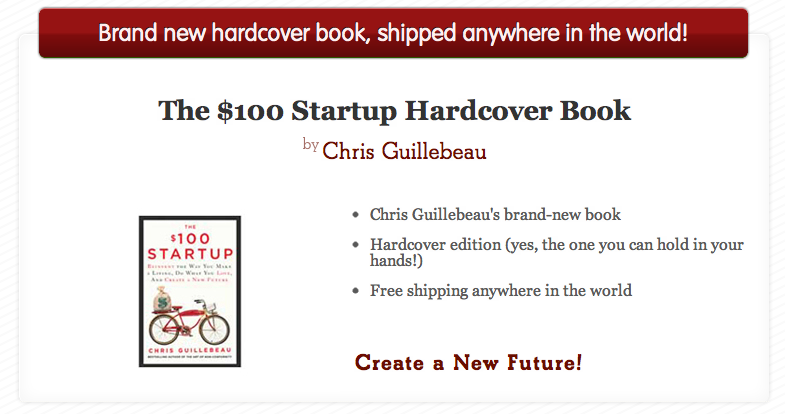
Chris’ most recent book is called the $100 dollar startup, which details how thousands of people have started businesses with less than £70 in their pocket and become huge successes.

I’m a big believer in both Chris and his message – and have actually achieved the very thing he is writing about, now that I’m self-employed and making a 4 figure monthly income from my adventures on the internet (which I started with just a website that cost me £6 a month for hosting).

So if you want to read the book, you’re in luck.

It’s not out for a couple of weeks but you can get it shipped to anywhere in the world (including the UK). It’s currently available in a larger bundle of business products around £60. And I think you should definitely buy the lot if you want to grow your pennies!

Along with the real-life book posted to your house, you’ll get £600 worth of information products about business for around £60!

But only for the next 72 hours….

As above, in addition to the hardcover book shipped anywhere in the world, this special bundle of information products at 90% off the true value.

Below is the full low-down (prices are in dollars so just imagine 2/3rds of the price for a dollar to British pound conversion…it’s a bargain in any currency, but only for 3 days!)


Products in this Only72 Sale (18 total):

Chris Guillebeau’s The $100 Start-up Book (Hardcover w/ shipping included)

Better Blogging ($177 in value) 

  • Corbett Barr – Creating, Marketing, and Designing A Blog That Matters ($40)
  • Susannah Conway – Blogging From The Heart (eBook version) ($137)

Passion-based Business ($137)

  • Jonathan Mead — Identifying Your Passion Module + Workbook ($97)
  • Scott Dinsmore — Live Off Your Passion (lite) ($47)

Freelancing ($111)

  • Ashley Ambirge — You Don’t Need A Job, You Need Guts ($40)
  • Men With Pens — Freelancer Package: Unbelievable Characters, Guest Posting Guide, Beyond Brick & Mortar eBooks ($70)

Confidence & Courage ($129)

  • Johnny B. Truant — Tao of Awesome ($79)
  • Marianne Elliot — 30 Days of Courage (w/ Yoga Module) ($50)

Selling & Advertsing ($144)

  • Pam Slim — Ethical Selling That Works ($97)
  • David Risley — Double Your Ad Income ($47)

Technology & Systems ($171)

  • Joshua Kaufman — The Personal MBA Guide to Small Business Infrastructure ($49)
  • Free The Apps — How to Make iPhone Apps ($97)
  • Brett Kelly — Evernote Essentials ($25)

Artists & Writes ($130)

  • Alyson Stanfield — Turning Your Hobby into a Career (download & audio program) ($51)
  • Chris Guillebeau — Unconventional Guide to Publishing ($79)

Click here to get all the above, but make sure you do it before by Thursday at 5pm UK time.


They say you have to spend money to make money.

In this case, I hope I HAVE persuaded you to buy this great set of products for a hugely discounted price, available for 3 days only.

I can genuinely say these writers and similar products have helped me grow my magical pennies, so I had to share this with you so you can do the same.

Adam


{ 0 comments }