Attending University without Student Loans

by Magical Penny on October 4, 2010

Previously on Magical Penny: Paying off UK Student Loans

When I started university in 2004 I took out student loans to pay for the three years of student life. There didn’t seem to be any other alternative. Where was I going to get the £3000+ a year (Now it’s £9000+) to pay for tuition alone!

No one else, including teachers, parents and friends had any answers.

Until now.

[click to continue…]

{ 6 comments }

Thirty Days and the 0.3 second Impulse Buy

by Magical Penny on September 30, 2010

I’ve just spent several hundred pounds, impulsively.
Not the most frugal of decisions but let me explain.

Other people’s money habits can drive you mad if you let them.
Have you ever found yourself thinking “You spent HOW MUCH on that?”

It’s not surprising.

Spending prioritisation and lifestyle choices are deeply personal so there’s rarely a one size fits all to personal finance.

Some scrimp and save on the little things and then buy a brand new car. Others live it large and then say they can’t afford to go on holiday or retire.

Magical Penny is here to encourage you to be more *conscious* of your spending and evangelise investing at any age, but when it comes to spending choices we can’t judge too much. Personal Finance is personal after all.

Blogging about money I’m perhaps more sensitive than most and I’ve often aware of contradictions that people have when it comes to their spending choices. Today, however, I’m going to share a recent contradiction of my own.

[click to continue…]

{ 6 comments }

Are you good with money? -A Magical Penny Video

by Magical Penny on September 27, 2010

It doesn’t take much for us to define our own strengths and weaknesses.  Most of us define what we do well and what we don’t do well in our formative years:

  • If you weren’t an avid reader in school it’s unlikely that you’re settling down with a paperback a few nights a week.
  • If football wasn’t your forte in the playground the odds that you play now that you’ve grown up are not high.
  • If you didn’t sing much as a child,  I doubt you’re singing professionally as an adult.

Of course there are exceptions but generally most of us are creatures of habit and we tend to stick to what we know.

But what about money?

Do you think you’re good with money?

By the time most of us start properly dealing with money we’re well on the way to adulthood. Unless your parents were particularly hands-on with teaching about money the vast majority of us have had to muddle through and learn from our own money mistakes. We don’t have many lessons on how to spend and grow our money.

Getting into the right money habits or escaping from bad habits is therefore critically important but the most important thing of all is getting the right mindset.

Maybe you don’t think you’re that good with money. If so don’t use past mistakes as an excuse not to be awesome with your own money management going forward. You can make a change.

Did you enjoy the video? Watch more now:

How to Not Get Ripped Off by Understanding Investment Prospectuses

Pre Tax and Post Tax Investing -Which is better? [Magical Penny]

{ 1 comment }

Save Money Easily- Reframing Your Saving

by Magical Penny on September 20, 2010


I’m back from my first visit to America and raring to go! If you’re new to Magical Penny be sure to join for free stuff and prizes by clicking here.

The purpose of advertising is to get you to Buy Buy Buy. But what if it’s a bank advertising their savings account? They want you to Save Save Save…with them.

Banks know that saving in itself isn’t the most interesting of subject for most normal people. Perhaps so, but its all a matter of re-framing  -a change of perspective.

One of the UK’s high street banks is doing a good job at this at the moment.  They are selling their savings accounts by drawing on much bigger life themes:

  • A special holiday
  • A child’s future
  • A wedding

The take home point? If you want to successfully save your pennies, reframing your savings by thinking of them as more than just numbers is key.

But how do you do it?

It’s important to keep focussed on an end goal.  You may think you know what your ‘end goal’ is but how to do you make it less abstract and more real in the here and now?

There’s lots of ways to bring about a change in perspective. Here a few ideas.

Keep a picture in your wallet

save moneyOne of the most common ways to gain a perspective on your spending is by keeping a picture in your wallet. Every time you look in your wallet to spend, you are forced to look at the picture. Perhaps it’s a photograph of your family. Or a picture of your dream house cut out of a magazine. Whatever it is, it should be something that will make you question whether the money you are spending right now is worth being one step further away from your goal.

Trent Hamm used a picture of his son to help him avoid trivial purchases that were moving him away from his larger goals:

“Whenever I pulled out my credit card, I’d see his face, and I couldn’t help but reconsider my purchase.” @TheSimpleDollar

Rename your savings accounts

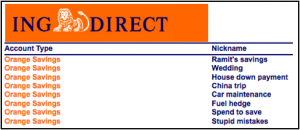
Many banks (especially those with online operations) allow you to rename your accounts. By naming an account for a specific item it can help you compartmentalise your savings, making it harder for you to justify spending them away.

ING Direct allows you do to this by giving your account nick-names. As does Natwest -here’s a screenshot of mine —>

Ramit uses his ‘sub-savings accounts’ for unexpected expenses:

“These sub-savings accounts are incredibly useful for focusing your savings. I’ve previously written about using them to hedge fuel costs, but in general, it’s easier to save for specific goals rather than a guilty, “I should save” account.” @Iwillteachyoutoberich

Keep a list of material wants

Many of us spend money impulsively, and there’s nothing wrong with that but when it comes to bigger purchases impulsive spending can get you in a lot of trouble very quickly! But if you start thinking a little differently about what you have to do to get what you want, you can work towards having almost anything you want.

For expensive items you need some perspective to  help avoid spending on something you will regret later on. For moderately expensive items I use a 30 day challenge to take the emotion out of the purchase.  If I still want the item 30 days after first wishing to have it, then I buy it. Before then it goes on the  ‘want list’.

For really expensive things like long distance holidays, house deposits and top of the range gadgets, I have a PowerPoint slideshow document of things that will take me much more than 30 days to save up to afford. This helps me keep focused and motivated on saving for these things consistently over time. You should try it!

Some of Adam's 'Wants'.

Remember,  you can still  grow your pennies and have almost anything you want. You just can’t have everything you want.

Open accounts in different places

A physical barrier can make you think differently and help you compartmentalise your finances.

For years I’ve had most of my savings with my bank but kept some money in a building society account (similar to a credit union for my US readers!). As the money is less accessible this strategy is really helpful for those who find themselves reguarly dipping into their savings accounts for everyday boring expenses rather than using their savings accounts to fund exciting things for the future -which is what growing your pennies is all about in the first place.

Why are you saving?

Saving should be a positive, life-affirming thing to do. It shouldn’t feel like you’re depriving yourself or stopping yourself from living for today. If you find yourself struggling to save, I hope you find some of these ideas useful for helping you to ‘reframe’ your savings as something more than the sum of your accounts.  Because saving your pennies have the power to shape your life for the better.

Good luck!

What do you find helpful in making sure you save?  Please leave a comment to share your experiences.

{ 5 comments }

The Freedom and Liberty of a Saver

by Magical Penny on September 1, 2010

A lot of personal finance is about cutting back, doing without -you know – saving.

But the real magic comes through the freedom that saving affords you.

A saver never says:

“I can’t afford that” or “I’ll never be able to do that

Instead a saver thinks:

“How am I going to going to get there” or “Let’s do it …because I can”.

Growing your pennies isn’t all about filling your bank balance.

It’s more than that.

It’s about having respect for your own life; dreams; and hopes.

It’s about making sure you priortise where you want to go rather than waiting for your circumstances to change on their own.

Saving also means you have the freedom to do more fun things too.

In fact I’m off to meet the lovely lady of liberty herself as I travel across the pond to New York City for my first ever visit to America! If you’re in NYC say hello!

Why are you saving?

What do you want to do with the freedom that growing your pennies affords?

{ 5 comments }

The State Second Pension -What you need to know

by Magical Penny on August 30, 2010

Magical Penny continues the  series on pensions.

Last week we looked into the state pension, which is paid for through your national insurance contributions. Even if you don’t save anything for retirement you will most likely retire with a state pension.

But did you know you probably have extra money coming to you in retirement (in addition to the state pension)? Money you don’t even know about?

Could you be getting extra money?

If you live in the UK and fit into any of these categories you’ll currently due to receive extra money on top of your normal state pension:

  • employed and earning over £5,044 (from any one job)
  • looking after children under 12 years old and claiming child benefit
  • caring for a sick or disabled person for more than 20 hours a week and claiming Carer’s Credit
  • a registered foster carer and claiming Carer’s Credit
  • receiving certain other benefits due to illness or disab

So what is this extra money?

The Second State Pension.

You may have noticed that the more you earn the higher your National Insurance contributions become. Certainly the more you earn the more you contribute to the state’s coffers but some of your  extra contributions go towards a ‘top-up’ pension known as the State Second Pension.

The State Second Pension is one of the most confusing parts of the current pension provision but its worth knowing the basics to make sure you’re not caught.

The most important thing you should know about it is that you may be faced with the option to ‘contract out’ –meaning you give up your Second Pension, start paying less national insurance and have the state to start contributing to your own personal pension.

It may sound good but you shouldn’t do it. Here’s why:

Don’t be tempted by the ‘free money’

If you have a pension at your place of work you should be given the option to  ‘contract out’ of the state pension and choose for the state to put money into your own personal pension.

‘Contracting out’, essentially giving up your second pension might seem like a good idea as you are given a rebate from the state that goes into your own pension that you control. The amount you could get varies by age and salary but, for example, someone aged 25 in 2009 earning £20,000 would have got  £1,128 paid into a personal pension on their behalf. A 45-year-old on the same earnings would have got £1,546 (slightly more as they are older and closer to retirement) Source

The money might seem nice but its debatable if it’s good value for money -you are trading away a safe monthly income at retirement for cash today. Will you be able to invest it well enough?

Being Proactive with your pension is not always a good thing

Magical Penny recommends being proactive with your long term savings but being proactive by ‘contracting out’ of the State Second Pension is the exception!

Whilst it is possible to do better than the state with good investing, you are most likely to underperform according to research undertaken by Which? in late 2005 which found that, contrary to expectations back in the 80s when contracting out was encouraged by many financial advisers and the government itself, millions of people are on course to be worse off in retirement as a result of contracting out.

By ‘ contracting out’ you are giving yourself an opportunity to try to better the returns the state promises for your retirement. This is a risk you shouldn’t take because it is the equivalent of leaving your eggs in one basket –you are banking 100% on your own investments – if your long term investments don’t grow as you expected you do not have the state second pension to help supplement your retirement. Why not invest on your own and have the Second state pension to fall back on?

That said, staying with the second state pension also carries a risk  as the pension rules are always changing and there might not even be a second state pension by the time you retire. However what the second pension automatically  provides you with should not be dismissed:

Saving for your long term is all about balance.

Certainly you should also be investing in your own savings plans rather than relying on the state to look after you in your old age, but if you choose to ‘contract-out’ you risk losing a safe and reliable income stream when you come to retire. If you ‘contract out’ your own investments will need to grow significantly to do as well as you would have done with the State Second pension, and when it comes to your retirement that’s a risk you don’t need to take.

The good news is that you don’t have to: most of us are automatically given a second state pension, a helpful supplement to your income during retirement. You should leave it well alone.

If you’ve never been a member of a private pension scheme then you can’t be contracted out. But if you’re an employee you’ll be able to contract through an ASP or APP. If you’re self-employed you don’t contribute to the state second pension and so can’t contract out of it. Also, if you’re not sure whether you’re currently contracted in or out, you can find out by calling the Inland Revenue Pensions Helpline on 08459 150 150. You’ll need your National Insurance number.

As with most tax issues, the calculations are quite complex so you should never rely on the state to provide you with the money you need in retirement. But don’t worry, Magical Penny is here to help you grow your pennies without needing to rely on the state. If you do get a State Second pension, treat it as a bonus.

Further reading on the State Second Pension

http://www.thisismoney.co.uk/s2p

http://en.wikipedia.org/wiki/State_Second_Pension

http://www.direct.gov.uk/en/Pensionsandretirementplanning/StatePension/AdditionalStatePension/DG_4017827

Click to access contracting_out.pdf

{ 2 comments }

Lust, Hunger and Desire

by Magical Penny on August 25, 2010

Update 30 September 2010: Find out what I decided to do after 30 days…

I’m lusting after the Desire. Don’t feel too sorry for me though. It’s only a phone.

It started innocently enough. Yesterday morning regular reader and friend The Other Adam sent an group email to a few of us as he’s decided to get a new phone. A few suggestions came back and I casually googled the phones. And promptly fell in love.

Love at first sight

I’ve had a total of only three mobile phones since my first in 2004,  all of which have been bought with cash and a Pay As You Go arrangement (prepaid phone credit). I’ve always wanted to avoid a monthly bill and didn’t use my phone enough to warrent paying £20+ every month. This plan has worked brilliantly for me over the last six years and avoiding by direct debits and monthly bills it has helped me build my savings by:

But all this is easy to forget as I imagine that huge touch-screen and Android apps…

Justifying New Purchases

If you are to be successful at growing your pennies and reaching goals you have to be mindful of your spending at all times. Even if you’re doing well you can’t relax completely because it can take years to grow your pennies and only seconds to spend them.

You have to be careful with your spending because your mind can quickly start rationalising purchases, regardless of whether they are in your long-term best interests.

For example here’s a few ways I’ve rationalised that I need to get this phone:

  • In the past I’ve not used my phone much but in recent months my usage has increased -I’ve enjoyed catching up with old and new friends and also started using the internet on my phone a lot more.This has been become more costly than originally calculated so if my usage were to stay the same a contract phone would be more economical.
  • I’m a huge advocate for the power and potential of the internet to enrich lives. Through the internet I’ve managed to maintain friendships that may otherwise have faded; heard about amazing opportunies I would have missed; and learnt new things to make  my life better in  many ways – having a web-optimised phone would allow me to embrace this internet revolution more effectively on the move.
  • This phone is highly rated on a number of websites, notably in this review.
  • My current phone has limited memory and limited capacity, and is not as shiny as this new phone -JUST LOOK AT IT!

So there you have it -undeniable proof that this phone is the best.

The 30 Day Test

Of course I’m aware I may be acting a little irrational. The human brain has its limitations and quirks.

If it didn’t no-one would be in debt or have problems growing their pennies over the long term -if it was a simple choice between financial freedom and debt what would choose?

I’m sure I’m not alone in my occasional desire to impulse-buy something that looks appealing. But if you follow your impulses too much you risk not meeting important financial goals (you have them right?).

One interesting idea is that of the 30 Day Test – for every item that is merely a ‘want’ rather than a ‘need’  you wait 30 days before reviewing the possible purchase. By giving yourself time to reflect you help to avoid making purchasing decisions you may regret later (and also give yourself a chance to save or cut back on other spending to compensate).

So the 30 day countdown is on and I’ve set a calendar alarm in my possibly soon-to-be- replaced-phone.

One of the fun things about personal finance blogging is being able to have this kind of  discussion about spending decisions that we all have to make but rarely talk about.

What do you think? Will I change my mind in 30 days? Should I get the new phone or stick with the phone I was perfectly happy with until yesterday? Leave a comment!

Update 30 September 2010: Find out what I decided to do after 30 days…

{ 13 comments }

The UK State Pension

by Magical Penny on August 23, 2010

What do you think of when you hear the word ‘pension’?

The Oxford Dictionary describes a pension as:

“…a regular payment made by the state to people of or above the official retirement age and to some widows and disabled people”

In the UK, this is referring to ‘state’ pension. In the US it’s called “social security”. In any case, this ‘regular payment’ is very small amount you are paid when you are old is just about enough to eat and keep the lights on, but not much above that. However it’s an important piece of the pension puzzle so you should at least know the basics.

Does Everyone Get a Pension?

As with most things tax-related, it depends.

The state pension is funded by national insurance contributions, the ‘tax’ you pay the state for all social services if you are earning £95 or more a week (in 2009/10). In the UK this includes your pension and the national health service. The amount of your pension is therefore linked to the number of years you have been paying National insurance contributions.

Note: if you’re a small business earning a profit of less than £5075 you don’t ‘have’ to pay national insurance contributions but it’s worth considering doing so if you are short of years to fully qualify for a state pension- see below).

Contributions

If you haven’t retired yet you are nearer to qualifying for a state pension than anyone else has ever been at your age. The old rules said you had to make contributions for 44 of the 49 years between the ages of 16-65 to receive a full state pension.

This has now been cut significantly after The UK Pensions Act 2007 which reduced the number of qualifying years needed for a full basic State Pension to 30 for people who reach State Pension age on or after 6 April 2010.

Even better if you fall short of the 30 years of contributions you can ‘buy’ extra years to make sure you qualify for the full monthly payment. You can also still receive a full pension even if you’re out of work for some of those years -as part of any unemployment or disability benefit your national insurance contributions are paid, so from a state pension perspective it’s like you were never unemployed.

You can also have your National Insurance contributions paid if you’re a full time carer so have other special circumstances so if you are not paying National insurance for any reason make sure you’re not missing out by visiting the UK government’s website: direct.gov.uk.

If you pay less than 30 years worth of National insurance you still get a partial pension depending on the number of years but there is a risk you may qualify for nothing at all if you pay less than 10 years of contributions.

Is a Basic Pension enough?

Knowing about Magical Penny and my enthusiasm for getting your long-term finances sorted, a friend joked to me that a state pension didn’t seem that bad. At least I hope he was joking -if you have minimal needs then perhaps he’s right. It is possible live on the state pension -millions do, but even the government says the state pension has its limitations on the direct.gov.uk website:

“It can give you a reliable foundation for your income in retirement, although it might not be enough to support the lifestyle you want.”

In 2010-11, a single person can get a maximum of £97.65 a week basic State Pension (£152.40 for a married couple).  Seem a bit small? Even the government recognises this -if this is your only income you can have your pension topped up with a ‘pension credit’ to a total of £130.00 a week (198.45 for couples).

Conclusions

The Oxford Dictionary might have been right about its definition of a pension as a ‘regular payment’ but its not as simple as that. The basic state pension is really helpful at almost guaranteeing you an income when you reach your advancing years yet, as this article has shown, tax rules are always changing and can be difficult to follow.

One thing is for sure though: Relying on a state pension will limit your lifestyle options.

Thankfully it’s never been easier to become empowered about saving for the long-term and Magical Penny will show you how in future articles in this Pension series.

Other Reading

Best Of Money Carnival #64

Carnival of Personal Finance #271 – The Secret to Successful Budgeting eBook Edition | Provident Planning

{ 0 comments }

I’ve just returned from the cinema where I went with my sister to see Toy Story 3. It may be about talking toys but it was filled with some wonderful script writing and it’s a thoroughly enjoyable film.

Amidst the humour and tension there are some powerful life lessons so here’s a few I picked up and how they relate to growing your pennies!

This post contains spoilers so only read if know or want to know the plot

Mistakes happen

Buzz and other toys should have been safely put away into the attic when Andy heads off the college. Instead, his Mum takes the toys out to the curb. Like the other Toy Story films the plot is driven by an accidental mistake happening and the attempt to put things right.

Life, for both the toys and ourselves, rarely goes smoothly.

Mistakes do happen. Yet the toys never give up in their mission to get home. Their determination is admirable and is a lesson for us all.

You will make mistakes (with your money and otherwise), the hard, but most important part, is that you pick yourself up and get your focus back.

The power of a well-executed plan

Escaping from being taken away with the trash, the toys take refuge in a box destined for day-care, but after reaching their destination, find that the centre is not what it seems.

They are trapped in a room with only a small window high above them.

It’s impossible for a toy to reach.

But, moments later, Buzz is flying through the air -or rather, falling with style – catapulted by a series of aerial stunts, to the promised land of the open window. It is a true testament to the power of a well-executed plan.

Just like looking at an impossibly high window, we face our own challenges in life: thinking about all the different things we need to buy in the coming years can be daunting. Cars, houses, weddings, retirement…it may seem unachievable sometimes. But if, like the toys, you develop a game plan, then with a bit of luck and creativity, you’ll get there.

Spend on the things that matter to you, not anyone else

Ken is teased for his extensive clothing collection. From an outside perspective it seems ridiculous to have so many outfits to wear but Ken is delighted when Barbie gives him the opportunity to wear them.

Many of us have the equivalent of Ken’s wardrobe. We spend our money on things that our friends or family don’t understand: perhaps piles of books, shiny electronics, or flash cars?

People often think personal finance is about cutting back, being sensible with your money.

It’s not.

It’s more about being conscious with your spending.  Certainly you should make sure you’re saving for your goals in the short and long term, but you should also not feel bad spending money in the present on the things that matter.

But also remember, Ken might have enjoyed his ‘stuff’ but he had even more fun when he had someone to share the experience with. As Suze Orman says: “People, then Money, Then Things.”

Mix it up a bit -you might just like it

In the midst of the adventure and daring escape, Buzz is reset to factory settings and reboots into a Spanish version of himself, much to Jessie’s delight.
Buzz’s Spanish transformation offers a much needed comedic element easing the tension that has built up, and Jessie finds a whole new side to Buzz, changing the way she feels about it forever!

Similarly in life, random events and meet ups happen all the time and can send your life down a whole new path. Being in control of your money makes it much easier to follow these opportunities. Certainly a budget helps you stay focused but it also allows you to ‘mix it up’ a bit which time and again can lead to a more fulfilling and fun life- and who doesn’t want that?

-To use a personal example, in recent weeks my budget has allowed me to head off to Ireland for an evening, and I’m heading to NYC in September!

It’s never too late to redeem yourself

Towards the end of the film, Ken sees the error of his ways and switches allegiances to Woody and the gang. It’s a risky move but Toy Story 3 teaches us that it’s never too late to be redeemed from poor judgement in the past. Woody even gives the evil, strawberry smelling, teddy bear an opportunity for redemption.

Likewise it’s never too late to redeem yourself from poor money habits or judgements you have made in the past. The sooner you get started on the right path to growing your pennies, the more time you have for your savings to grow.

Life goes by so fast

I remember when Andy was young, playing with Woody and Buzz in the first Toy Story film. By Toy Story 3,  Andy has grown up and is moving to college. Life goes by so fast!

  • You may think you’ve got ages until retirement or before you get started on the property ladder but it will come around so so fast.
  • You may think you’ll begin saving when you’re earning more money.
  • You may think you’ll start learning about investing when you have a little more time.

But, like Andy, you’re growing up fast

Toys fear their owners growing up and not playing with them anymore. Thankfully we don’t have to fear the future. Follow through with a plan and we can embrace it.


{ 5 comments }

Final Salary Pensions

by Magical Penny on August 11, 2010

Pensions shouldn’t be the scary, confusing, or boring. But they are. And for good reason!

They are rarely flexible, have expensive fees, and worst of all, are seen by many as something you start in middle age.

As you’re reading Magical Penny I hope I’ve convinced you that you should be saving for the long term whatever your age but navigating the dizzying array of options out there can be difficult.

Today, I’m beginning to lift the lid on pensions with Part 1 of the Magical Penny Pension series, helping you find the best way to grow your pennies for retirement.

To begin we’ll be looking at the traditional final salary pension.

Final Salary Pensions

The traditional pension of the 20th century was that of a ‘final salary’ pension: Many professional jobs offered such a scheme where every month you and your employer would pay into a ‘pension fund’, an investment account that would grow over time. When you came to retirement, you would then receive a ‘pension’ equal to a proportion of your ‘final salary’ depending on the number of years you have worked at the company.

The great thing about final salary pensions is you can work out how much your pension will be each month.

For example if your company offers you a 40th of your final salary as a pension and you work for the company for 20 years ending on £40k a year, you will retire on half pay (your pension will be: (40000*0.025)*20 =£20k a year).

This type of pension is known as a “defined earnings” pension as you know how much your monthly income will be. You don’t have to know anything about investing but still finish with a comfortable retirement income for the rest of your life.

Another compelling reason to have one is how generous they can be. You do not have to save as much nor take on as much investment risk to secure a good income in retirement. If you wanted to guaratee a £20000 a year income without a final salary pension scheme you would need your pension pot to be hundreds of thousands of pounds.

As it is ‘defined earnings’ it’s the pension fund’s responsibility to pay you what you are promised. Compare this to if you were investing yourself into a pension ‘defined contributions’ -if your investments go down you are out of luck and money, but if a final salary pension fund loses value, the fund goes into debt in order to keep paying you!

Whilst final salary pension schemes have their merits they can also be troublesome:

If the investments in the pension fund do not grow as expected, the pension fund can end up with a deficit (debt). This can cause all sorts of problems and if you have not yet retired some schemes have been known to be ‘creative’ with their calculations on what they are able to pay you as a pension when you eventually do retire.

Also the rules differ on how the final salary is calculated so if you have such a pension make sure you understand it. Some schemes take an average of your salary during the last 5 years, whilst others look only at what you were earning in your last year.

Others still might take an average of what you earned for the past 10 years then divide that by the number of letters in your name, then multiply that by pi. You think I’m joking?

It is worth noting too that there have been been instances where ‘final salaries’ of employees have been cut just before retirement so their final pension is dramatically reduced.

There is therefore an element of luck involved and when we’re talking about the income you will be receiving for the rest of your life who wants that?!

Final salary pension schemes also tend to unflexible and non-transparent. You are likely to have little control over the investments in the fund. There may be instances where you feel uncomfortable not knowing where your money is going each month, particularly if the investments chosen are not deemed ethical by your standards.

Another thing to consider  are costly fees for administration and commissions.You wouldn’t notice them as they come out of the pension fund itself but your company’s investment returns calculations will have included them so the odds are you are getting a lower rate of return than if you had set something else up as your retirement savings vehicle.

Lastly final salary pension schemes can also act as ‘golden handcuffs’ -if you know you will give up a guarateed £20k for life you may be less inclined to leave the company before you retire, even if it would otherwise be the right thing to do for your career, your family, or yourself.

Conclusion:

Final salary pensions work well if you are with a company for many years. But the world is very different now than when such schemes were being introduced in the 20th century.  It is unlikely you will be at your current company for decades. Moving from job to job could result in numerous pension accounts scattered around different providers and final salary pensions are harder to calculate and understand so make retirement planning more difficult.

Final salary pension schemes tend to be quite generous but they are becoming increasingly rare. Companies do not want to take the financial risk of having to pay out the ‘defined earnings’ and adminstratively it is costly, particularly as people are less likely to be at their current job for a lifetime.

Despite their flaws, if your company does offer a final salary pension scheme it makes sense to join given how generous they tend to be. That said, as final salary pension schemes are not always straightforward nor do you have much control, it should not be your only retirement savings strategy.

Thankfully there are many other ways to save that are less complicated, and Magical Penny will detailing them in later posts in the series.

If you have a final salary pension scheme leave a comment if there’s anything you would like to share about it to help other readers!

{ 1 comment }