How To Get Your 2012 Off to a Good Start

by Magical Penny on January 19, 2012

The following is a guest post by Liz Goldman for Sunbird FX – the currency trading specialist and CFD broker.

According to a U.S. government survey, making better financial decisions is one of the top new year’s resolutions made by Americans, along with vows to lose weight and get more exercise. It’s a great time to make sure you’re getting 2012 off to a good start financially. Here are some ways to give yourself a financial check-up:

Shop around for better interest rates

Interest rates on savings accounts are rock bottom right now, so it’s particularly important to do the best you can. Check local banks, credit unions, and online financial institutions. Make sure there are no fees or hidden terms. Some accounts that look good on the surface are bad deals when you read the fine print.

Shop around for better credit card terms

Banks tightened up on lending, dropping credit card limits and closing accounts, during the worst of the recession. Now many are looking for new customers and dangling attractive introductory rates and reward programs to entice them. The best credit cards often have annual fees, so make sure you’ll get enough benefits to make the cost worthwhile. Ask if the card issuer will waive the fee for the first year. If you find a card with a zero interest promotion, transfer a balance from a high interest card.

Pay more money on your highest interest credit card account

Interest eats up a big chunk of your monthly credit card payment if you’re only paying the minimum due on that card. You’ll lower the actual balance more quickly if you channel more money toward a high interest account. It’s gratifying to see the balance drop more quickly, and once you pay off one of your cards, you can use that extra money to tackle another high interest bill.

Increase your savings

It never hurts to have a money cushion for unexpected bills like car repairs, dental emergencies, or anything else that suddenly causes a major expense. A hefty savings account also cushions you against the effects of a crisis like job loss. Determine how much you can afford to pay each month. Write a check and deposit it into your savings account at the same time you pay your monthly bills. Treat that deposit with the same importance as you’d treat any other bill.

Order your free credit reports

…and make sure no mistakes are bringing down your credit score.

The Fair Credit Reporting Act entitles you to free reports from the three credit bureaus every 12 months. Order them through AnnualCreditReport.com, comb through them carefully, and file disputes on the appropriate credit bureau websites for any problems you find. You may be doing great financially, but a mistake or two on your credit reports can still destroy your credit score.

Talk to a credit counselor

…at a non-profit credit counseling agency if you’re having trouble making a workable budget on your own. Many people think that credit counselors are just for people teetering on the brink of bankruptcy, but that’s not true. Legitimate counseling agencies offer a full spectrum of services, not just debt repayment plans. Find an agency that offers free counseling and educational resources and check its standing with the Better Business Bureau.

_______________________________

Thanks Liz for this post.

Tips are really useful, but also remember, mastering your money is as much a mind-game as it is about taking action on these tips.

Do you have the right mindset for success and wealth in 2012?

Watch the video to find out why mindset is so important.


{ 0 comments }

20 Money-Related Jargon Terms & What They Mean

by Magical Penny on January 12, 2012

Managing your money can be tougher if you don’t understand some of the jargon.
So knowing what different terms mean when it comes to saving money and choosing a savings account can mean the difference between maximising your savings or giving it all away to your bank.

Here are a few terms to help you get started.

    1. ATM: ATM is short for automated teller machine. An ATM is a machine that is generally located outside your bank that allows you to deposit and/or withdraw cash from your savings account 24 hours a day 7 days a week.
    2. ATM Card: An ATM card is a plastic card with a magnetic strip on the back that is encoded with your account information. When inserted into an ATM, the mag reader decodes the information located on the mag stripe on the back of the card and allows you to access your savings account.
    3. Balance: Your balance is the amount of money you have in your savings account.
    4. Deposit: A deposit refers to the amount of money you are putting into your savings account at any given point.
    5. Direct Debit: A direct debit occurs when a payment is made directly from your savings account. This occurs more often with current accounts (known as ‘Checking’ accounts in the US and Australia, but can affect savings accounts as well. Think of it like something that ‘pulls’ money from your account…rather than a standing order that does a similar job but it is you ‘pushing’ money into another account.
    6. Electronic Banking: Electronic banking refers to the process of accessing your savings account via the Internet or mobile device to check your balance, set up a payment, or make a deposit. This can also be referred to as Internet Banking.
    7. Excess Usage Charge: Many banks will assign a limit to the number of transactions (deposits/withdrawals) you can make from your savings account each month. When the number of transactions exceeds this assigned limit, the bank will charge your account a fee.
    8. Interest Rate: The interest rate is the amount of interest your bank will pay you for the privilege of being named the custodian of your cash. Most, but not all savings accounts will earn interest on the balance of your account. In this case, the higher the interest rate, the better your rate of return on your deposit. There are two types of interest: simple and compound.
    9. Online Account Opening: This term refers to the process of opening a savings account with a bank through the use of a computer and the Internet.
    10. Over the Counter: Over the counter refers to the process of making a deposit or withdrawing cash from your savings account within a bank branch.
    11. Overdrawn: Being overdrawn means that you have withdrawn more money from your savings account than you had available. Most banks will allow your savings account to become overdrawn in certain instances and charge a fee.
    12. Personal Identification Number (PIN): Your PIN number is a code used to access your savings account when using an ATM or Internet banking.
    13. Savings: Savings refers to the money you set aside for use at a later time.
    14. Savings Account: A savings account is a bank product designed to help you with your savings goal. You deposit the money you wish to save into your savings account and allow it to grow with each subsequent deposit and interest payment.
    15. Simple Interest: Simple interest is the amount of money your bank pays you based on the balance in your savings account. Some banks pay monthly while others pay annually.
    16. Statement: A statement is a record of all of the activity on your savings account for a 1 month period. Deposits, withdrawals, payments, and interest will all be recorded on your monthly statement.
    17. Teller: A bank employee whose job it is to assist you with your banking transactions.
    18. Terms and Conditions: These are the rules that govern your savings account. The cost of maintaining an account, the interest rate, and many other details are included in your account’s terms and conditions.
    19. Transactions: The movement of money into or out of your savings account.
    20. Transfer: The movement of money from one account to another.
      1. And these are just a few of the terms you can familiarise yourself with in order to become a more savvy saver. Becoming a more knowledgeable about the terms used will help you make wiser decisions regarding who you choose to watch over your money.

These tips are brought to you by Andy, the co-founder of SavingUp.com.au, a comparison website specialising in savings accounts. Check out their guides to saving money for more helpful articles.

For more about Saving Money check out these other Magical Penny articles:


Should You Get A Junior ISA? | Junior ISA Explained

Saving Money – Learn By Doing

Confessions of a Procrastinator -And Why You Should Be Saving For Retirement Today


{ 2 comments }

Festival of Frugality #318 | Magical Penny Edition

by Magical Penny on January 10, 2012

Welcome to the Festival of Frugality #318 Magical Penny edition, brought to you from the UK by Adam from Magical Penny.

Click to read more and watch the video

{ 46 comments }

Hitting ‘Publish’ on your Saving goals

by Magical Penny on January 8, 2012

When I blog, nothing else matters if I don’t hit ‘Publish’.

Without pressing the ‘Publish’ button all my intentions and planning and behind-the-scenes work has no effect.

Do you ‘Hit Publish’ in your life?

Similarly, reading personal finance blogs and books are great for getting you more clued-up, but if you do not ‘hit publish’ by opening a savings account or setting up an investment portfolio then you’re not going to building your savings up for the long term.

Hitting publish is scary.

You’re making intentions real. And if they don’t work out, then you open up yourself to the possibility of  potentially made a bad choice.

  • What if I can’t afford to save a certain percentage of my income?
  • What if I pick bad investments and lose money?
  • What happens when I try my hardest to put money away but I have to dip into my savings?

You won’t know until you ‘Hit Publish’ on your plans

I started in investing in October 2007.

cautionYep, the peak of the stock market before the crazy ‘crashes’ of 2008 and 2009.

But I’m so glad I did. If I had waited just a few months I’m sure I would have freaked out as I watched investments around the world go lower and lower. But I had started so I kept going. And, in fact, as I continued to invest into tumbling stock markets I’ve actually come out ahead so far. Four years of investing and my investment accounts are in the positive, and currently value much more than they would have been if they had simply been saved in cash.

I ‘Hit Publish’ on my investing plans. And I have continued to invest and learn.

It’s January as I write this. Money is tight for most of us after Christmas spending. You may be tempted to wait to get your money-game in order because it’s not the right time.

But, it’s never the right time.

There’s always more research we could do, or wait until a more favourable time when we have more spare time or spare money. But that time never comes.

Hit Publish. You’ll learn so much on the journey and it’s easier to tweak your plans once you’ve started than getting started.


Hit Publish.


{ 1 comment }

2011 in Numbers

by Magical Penny on January 5, 2012

2011 was a crazy year to be an investor.
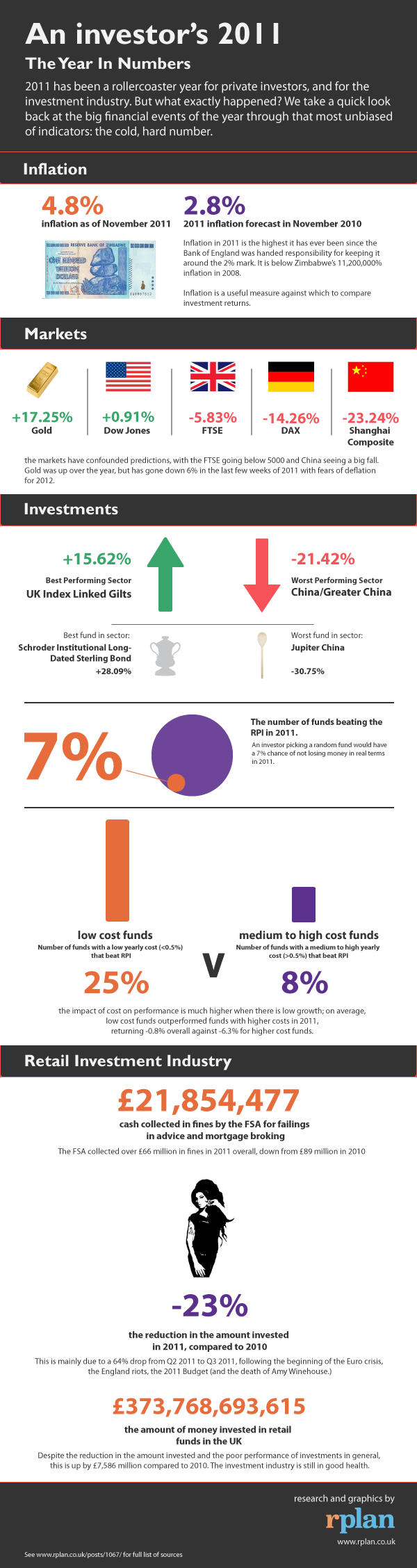

Even someone with relatively small portfolios could have lost thousands of pounds in a month. I know I did!

I recently came across a great info-graphic that sums up the year well, particularly the fact that low-cost funds out-performed higher cost funds. You may think this is obvious but when looking to invest, the higher cost funds are the funds that have advertising budgets and marketing designed to make you pick them over cheaper funds.

There will be more posts at Magical Penny explaining how to invest in low-cost funds so be sure to sign up for updates but, for now, enjoy the info-graphic.

Source: https://www.rplan.co.uk/post/1067/an-investor-s-2011-the-year-in-numbers-infographic

Which figure surprised you the most?

Leave a comment below.


Other Magical Penny articles you may like:

Losing £1000 in the Markets in a Month | How To Invest Profitably and Care-Free

3 Reasons to Open a Self Invested Personal Pension

{ 1 comment }

I’ve found reading personal finance blogs a brilliant way to learn about the best ways to save and invest. But, apart from saving tax-efficiently in ISAs I didn’t really know much about tax strategies until recently.

After talking with a new friend we decided to team up to launch a new website for 2012 on the subject of tax:

Introducing: Tax On Tax Off.

The site will help you understand tax issues, particularly if you’re based in the United States. Filing taxes might not be the most fun thing you can do, but there are lots of opportunities to save money and ensure you are not paying too much tax (or too little).

We launch in the new year and we’d love for you to follow along, ask us your tax questions and we look forward to helping you rock your finances when it comes to tax.

And, oh yes, it will be FUN too.

Put in your name and email and start learning about how to save your money from the Tax Man:


{ 0 comments }

Should You Get A Junior ISA? | Junior ISA Explained

by Magical Penny on December 20, 2011

A Junior Individual Savings Account (ISA for short) is a new financial product available in the UK (I can tell you’re excited already!)

Launching at the start of last month (November 2011) the product allows parents to save money for their children in a tax-efficient way, without needing to use their  own ISA and therefore saving their tax allowance for themselves.

What the UK Government has to say about Junior ISAs:

“Junior ISAs are a great example of a simple, clear and jargon-free financial product that allows families to save and invest for their child’s future,”

Mark Hoban, financial secretary to the Treasury

I wouldn’t exactly say they are jargon free but hopefully by the end of this article you’ll have a better idea about them and know why they are so worthwhile.

Firstly, some context: They were brought in to replace the Child Trust Fund that was introduced by the Labour government and scrapped by the coalition.

If you already have a child trust fund (CTF):

If you already have a CTF then you will not be able to apply for a Junior ISA, but you on’t miss out on the tax savings because the CTF investment limits have been increased from £1200 to £3,600 a year  -the same as the Junior ISA.

If you haven’t got a child trust fund for your child: 

If your child doesn’t already have a trust fund then a Junior ISA is something you should consider (even for older children who did not have the option of CTFs because they were born before 2002. And if your child is 16 years old they can open one themselves, and then convert it to a normal ISA at 18 (assuming they are sensible and don’t spend it on alcohol and parties!)


So what actually is a Junior ISA?

A Junior ISA for children  is, in many ways just like a standard ISA for adults – a savings account that allows you to save in cash or through stocks and shares, and not pay tax on your gains (you pay tax on interest from normal savings accounts but you might not realise it because it is automatically taken out of the interest you receive).

There are lots of advantages to investing in a Junior ISA:

  •  It is tax efficient:  The Junior ISA allows your child to avoid paying tax on the gains from savings, meaning the money grows faster than it would in any other account with the same interest rate.
  • It takes full advantage of the power of time: All money put in a Junior ISA is eventually rolled over into standard ISA at once your child turns 18 – keeping the tax free status…this is particularly brilliant as it means you’ve had more years to put money into the tax-free system for your child. If you had simply saved in a normal account and then wanted to transfer it into an ISA later on, you would be limited by how much you can put in an ISA in any given year. Saving in a Junior ISA consistently every year will allow you to save a substantial amount for your child.
  • It teaches the lessons of saving: Opening a savings account that is not accessible but is transparent (you can see the balance) is an incredibly powerful tool for teaching children the lessons of saving. They will be able to watch the balance grow over time and if you have invested it in the markets you will also be able to teach and show them the power of compounding returns as well as demonstrating the concept of risk and return.
  • It’s easy to pay into:  It’s really straight forward for donors to give. Adults paying into a junior ISA are not subject to full money laundering procedures usually associated to paying into other people’s savings accounts. This is important because it’s likely that the child themselves will not be paying into the ISA because they don’t have an income. But it’s easy for anyone, including grandparents and parents to pay into. What a great Christmas present!
  • It’s possible to switch from Cash to Stock AND BACK AGAIN. Children can hold one cash and one shares Junior ISAat a time, with the maximum £3,600 a year split between them.With a standard adult ISA you can transfer funds from a cash ISA a stocks and shares ISA…but you can’t transfer back into the cash ISA without taking the money out of the tax shelter. However, with a Junior ISA it is possible to transfer between cash and stocks and back again as many times as you want. This is great if you are uncomfortable with the level of risk at any time as you can correct your asset allocation whilst allowing the money to remain the tax-free status of the money in the  Junior ISA.
  • It’s perfect for parents to gift money to their child. In an ordinary savings account, interest exceeding £100 on any amount deposited by the parents will attract tax at the parent’s tax rate. Not so in a Junior ISA -it’s all tax-free.
Despite the advantages, it’s worth knowing the disadvantages too:


Disadvantages:

  • The money is locked into the Junior ISa and cannot be withdrawn until the child reaches 18. And it is always the child’s money once it enters the account. If you wanted more control you would have to skip the ISA, save in your own accounts and then give money to the child once they reach 18.
  • The Junior ISA replaces the child trust fund, which the government made contributions to. But the Government does NOT make contributions to a Junior ISA. All together now: “BOOOOO!”
  • There are ways to get around the tax situation without a Junior ISA. If a normal children’s savings account is funded by a grandparent or other generous relative who is not the parent, interest up to the child’s personal tax allowance – this year a huge £7,475 – can be socked away tax-free….without the restrictions of a Junior ISA.
If you are not using your own ISA allowance completely then you should consider saving for your child that way for the most flexibility, but if you are ARE using all your allowance for your own needs (you should be trying to) then a Junior ISA is a great solution for saving for your children’s future needs.

 It’s a great product for helping you save for a child in your life.

Why not consider setting up a Junior ISA as an amazing Christmas present?

{ 3 comments }

Work, Risk and Death

by Magical Penny on December 19, 2011

Dont work yourself to death Source: www.ConstructaQuote.com


Stay safe out there and keep money in perspective. And, if you have people who are dependant on you, life insurance doesn’t hurt, either!

Also on Magical Penny

Do you need health insurance?

Some financial preparation for after you’ve gone

Do I Need Life Insurance?


{ 0 comments }

7 Things to Look For in a Balance Transfer Deal

by Magical Penny on December 4, 2011

Using credit cards

A guest post from Andy about credit cards….useful things if used responsibly.

A balance transfer can be a good idea because it can help you to decrease your debt. You can transfer the amount of money that you owe on a credit card, for instance, to another lender.

With a ‘super’ balance transfer, you can even transfer the amount that you owe on a personal loan or your overdraft from your credit card. This is one of the easiest ways to save money because these cards will not charge you anywhere near as much in interest, in fact, in the UK most of the top cards don’t charge any interest at all for over a year.

If you are having trouble making your payments or reducing the amount that you owe because the interest rates are too high, this is certainly an option that you should explore. Below are a number of things that you need to look into when you are going over the various options that are on the current market.

1. The Promotional Interest Rate

First, you must look at the interest rate that you will get when you first open an account. If this is not lower than what you are currently getting, the transfer will not be helpful at all. You need to try to find the lowest interest rates that you can – thankfully most balance transfers are 0%. Sounds too good to be true? It’s not. You’d be silly not to take advantage of it.

2. How Long This Promotional Rate Lasts

The next step is to see how long this rate will apply to any balance being transferred. If the low rate only lasts for a month, it won’t be very helpful at all. In the UK, the market is so competitive that nearly all balance transfer offers are interest free for at least a year, but some (like those offered by the Barclaycard Platinum and Halifax Balance Transfer Card) offer nearly two years interest free on balance transfers. Therefore, it is important that you look at this in connection with the interest rate and not just at the rate itself.

3. What the Rate Reverts to When a Balance Still Exists

After that, you need to work out what the rate will change to after the promotional period ends. It may be possible for you to find a deal that will never change, where you will be locked into the low interest levels until everything is paid off. This is not common, however. The vast majority of balance transfer deals will revert to a higher interest rate after their promotional offer expires. If you do not think that you can get everything paid off before this happens, you need to know how much the rates will jump so that you can see if the deal is really as good as it sounds.

4. Additional Fees and Charges

Do not take out any balance transfer offers until you know exactly what additional costs will be involved. In the UK it is standard practice to be charged a balance transfer administrative fee, typically in the region of 3% of your balance. You need to know how much all of this will cost because this can help you to see if transferring your debt is even worth it. If you have to pay out more than you will save, you should not make the transfer.

5. Limitations Regarding Transfer Totals

Furthermore, you need to see if there is a maximum limit regarding how much debt you can even transfer over in the first place as some banks will only allow you to transfer so much. If you have £10,000 of debt, you need to make sure that you do not apply for a balance transfer that only allows a maximum of £3,000.

6. Your Status as a Customer

Some banks will require you to be a customer before you can actually open an account and apply for a balance transfer. However, these tend to be in the minority of offers – most offers are open for application by anyone. Regardless, check first if the balance transfer offer you want is available only to existing accountholders.

7. Your Personal Credit Score

It also does not hurt to find out how your credit score impacts your rates. If you have a high score, you can sometimes get a much better deal given that most of the banks have variable rates on both balance transfers and purchases. If your credit history has been tarnished in the past, then do not apply for the most competitive deals on the market as they are reserved for those with excellent credit. Instead, people with impaired credit records should look for a credit builder credit card with a balance transfer rate. Of course, if your credit score is in the excellent range, then you can apply for a much broader range of offers.

Andy is the co-founder of Finance Choices, a comparison website offering UK consumers an easy and impartial way to compare a range of credit cards for people with poor credit.

{ 2 comments }

If you’ve ever considered some kindling to help that entrepreneurial spark of yours become a raging fire, then I can’t recommend this sale more highly. It’s made up of products from many ridiculously awesome people doing great things online.

And you can learn how they do it!

I’ve met many of these authors personally and know they are doing some world-changing stuff.

Check it out.

It’s only around for 72 hours.

{ 0 comments }