Best Digital Marketing Channels to use for Short Term ROI

by Magical Penny on November 28, 2012

EmailOne great way to grow your pennies in this internet age, is through online pursuits, in particular, digital marketing.

And  you don’t need a big budget to start: when it comes to sheer cost effectiveness, you simply cannot beat digital marketing.

That’s what we’ve all known for some time, and indeed recent research published by analysts GfK has confirmed this, showing that online marketing campaigns are directly competing with press and outdoor advertising in terms of who they can reach – and actually outstripping offline channels when it comes to delivering a short-term return on investment (ROI). Looking at eight separate marketing campaigns for consumer goods, researchers found an average ROI of 75p for online campaigns, compared with 66p for press and just 53p for outdoor advertising.

The best routes to digital success

Given the proven effectiveness of digital marketing, then, what are the fastest and best digital routes to this healthy ROI? The online marketing trade body, the Internet Advertising Bureau, has pointed the way, by noting that the most cost-effective digital advertising campaigns often make cunning use of search engine optimisation and Google Adwords, as well as social media and email marketing. The latter is exceptionally effective, particularly since the initial harvesting of email
contacts to form the necessary database can act as the foundation for other, later campaigns.

The ROI potential of email marketing

There are many online marketing companies that specialise in email marketing and can provide you with various resources, from free email templates to all-singing, all-dancing email marketing software, which not only helps identify and gather contacts, but can also manage the database and ensure that all marketing emails are targeted to the right customers at the right times and can analyse and identify trends, strengths and weaknesses. So how effective is email marketing in terms of ROI? Well in the USA, the Direct Marketing Association said that the method’s ROI for 2011 stood at $40.56 for every $1 invested, which is pretty impressive.

Social media amplified by email integration 

When you combine this bedrock digital channel with some of the fastest-growing developments, the possibilities multiply exponentially. The phenomenal growth in social networking, especially into more targeted and niche areas via the likes of Tumblr and Pinterest, has made the potential for integration impossible to ignore. Marketing emails can point customers towards blog posts, promotional tweets or fan pages, and these media can avertise special offers, email newsletter subscriptions and other aspects of your email marketing strategy.

Joining the mobile revolution

The other unmissable development is mobile devices. All of the above should be mobile-optimised, to take advantage in the huge growth in online sales conducted while on the move. Email templates should be intelligible and attractive when viewed on smartphone or tablet, as should all social media. When it comes to short-term ROI, these most immediate forms of digital marketing are unbeatable when it comes to delivering bang for your buck.

{ 0 comments }

Essential Skiing Kit for Winter Breaks

by Magical Penny on November 27, 2012

Hitting the slopes is a great way to enjoy yourself over the festive season, so make sure that you take safety into account before you get your skis on.

Having an accident abroad can be expensive and incredibly inconvenient, so make sure you’re aware of the steps that you can take to safeguard yourself, particularly if you’re going off-piste.

Your essential skiing safety kit should include:

A small backpack for essentials on the mountain – choose something comfortable to wear and lightweight. The contents should include spare gloves, a screwdriver, a bottle of water (at least half a litre if you’re off-piste), and an energy snack. Getting on and off the slopes is time consuming, so once you’re on for the day you need to have the essentials at hand.

  • Sun cream and lip block to protect you from burning – reflection from the snow itself is a huge factor, so make sure you’re protected.
  • A small first aid kit to enable you to treat scratches, bumps and bruises
  • A mobile phone, in case you should sustain any injuries that can’t be fixed with your small first aid kit. Smartphones which include satellite navigation or a compass can be very useful too if you’re skiing away from familiar routes, and maintaining some form of contact with others is important. It is even possible to find gloves which work with touch screens, allowing you to check your course without having to take gloves on and off.
  • Health insurance details, just in case of emergencies! Hopefully you won’t need this information, but keeping it safe in your hotel room is always a good idea should you need it.
  • A map. An obvious piece of kit that you’ll need, but one that many people forget!
  • Spare goggles, in case your other pair is scratched or damaged (should you fall, for example). Goggles are absolutely essential for good visibility and protection, so a spare pair is handy to keep in your backpack.

Staying safe will help you to enjoy your winter break, so as well as your ski jacket, boots and hat, make sure you have the above stashed in your case before you jet off!

{ 0 comments }

The Rarity of Coloured Diamonds

by Magical Penny on November 26, 2012

sell diamond ringWhen it comes to investing, diamonds are a consideration due to their indestructibility, high value and stability (in addition to other investments of course). However, many grow confused when it comes to buy diamonds due to the large variety that are available.

Diamonds are still widely thought of as glittering transparent gems, but the truth is that diamonds not only come in all shapes and sizes, but in all colours as well.

Coloured diamonds

Buying coloured diamonds is an increasingly popular option for the savvy investor and the discerning gift-giver alike. This is partly due to their unique beauty and partly due to the fact that they are among the rarest – and thus the most valuable – of all diamonds. Coloured diamonds gain their hue from combinations of trace minerals and other geological elements present at the time of their birth in the depths of the earth. When you see what goes to make the various coloured diamonds, you can appreciate what a rare and precious item they are.

Blue diamonds

It’s boron which alters the conductivity of the diamond during its earliest formation and turns it blue. One of the most famous diamonds in history – the Hope Diamond – is a blue diamond, cut from the French Blue Diamond after its theft in 1762. Today, you can see the Hope Diamond in Washington’s Smithsonian Institute, or possess your very own blue diamond through accredited brokers.

Green diamonds

It is radioactive exposure that makes a diamond green, so elements such as uranium in the earth will have this effect. The 41 carat Dresden Green is the most famous of its kind, with records of the gem dating all the way back to 1722. It remains in Germany, and has been on display in Dresden Castle for over 200 years.

Yellow diamonds

Nitrogen is one of the most common elements on the planet, yet its presence during the formation of a diamond creates one of the world’s rarest and most beautiful stones. The most celebrated yellow diamond is the massive 101 carat Allnatt diamond, currently the possession of the SIBA Corporation.

Pink Diamonds

The glowing pastel pink of a pink coloured diamond comes from a crystal lattice fault developing during the stone’s formation. This does not stop them being highly rare and valuable, though – especially such gems as the 32 carat Agra diamond, also owned by the SIBA Corporation.

Black Diamonds

Unusually, these diamonds are opaque, without sacrificing any of their sparkle or lustre. They derive their colour from tiny carbon clusters. The huge 202 carat Black Star of Africa is the world’s largest coloured diamond.

Red Diamonds

All coloured diamonds are rare, and the rarest of all is the red diamond, of which only a few examples have ever been found. The red colouring occurs for the same reason as pink diamonds but the exact kind of crystal lattice defect is far rarer. The most famous red diamond is the Moussaieff Red. Although it weighs just over 5 carats, it is by far the rarest coloured diamond.


Whilst diamonds can certainly be considered an investment, make sure this commodity is not your only investment. Here at Magical Penny we are big proponents of equities investing, so do read more articles about investing.

{ 0 comments }

Investing in the markets is one of the best things you can do to grow your money.


Every day companies create value in the world and by investing in the stock market you have an opportunity to own part of those companies.

As an avid investor I’m always looking for better ways to achieve my investment goals. The internet has changed everything for investors as you can have information about investments at your fingertips unlike ever before.

But are you investing right?

 

When you think about investing what comes to mind?


A much better option is investing in a wide selection of companies that have been grouped together into a ‘mutual fund’.
By buying a share in a mutual fund you essentially own tiny proportions of many different companies. Over time, most companies make money (or they wouldn’t exist for long) so you get to benefit from the average growth without worrying about losing all your money in the few companies that get into financial trouble.If you are like most people, you associate the word ‘investing’ with buying shares in individual companies. However, for most, this is not a good option unless you are willing and able to do in-depth research into the balance sheets of publicly traded companies.

Think of it as ‘Less-stress-Investing’.
But not so fast…there still is work to do…

The trouble with mutual fund investing

It is easier than ever to set up a portfolio made up of mutual funds. But, unfortunately, with all this information available it is also easy to get overwhelmed when tracking an investment portfolio – how the various funds are performing, and how much they are costing you.

Enter rplan

rplan are a startup company based in London that aims to simplify the process of keeping track of your investment portfolio.

They have recently developed a new tool for users to create and track investment portfolios. The tool is still in the testing phase, but Magical Penny was offered an opportunity to try it out and offer feedback for the rplan blogger challenge.

In a nutshell rplan’s portfolio tool is a comparison web app to help you buy the best funds with the lowest fees.

This is incredibly significant because every other investment platform I have ever used, hides the REAL TOTAL COST of a mutual fund.  Naturally, investment companies make more money when investors choose mutual funds with higher management fees. But higher fees are no guarantee of investment performance. In fact, over the long term, the amount a fund costs to run has a significant impact on the overall return of your investment.

 Using rPlan’s portfolio tool to monitor total expense ratios of a portfolio enables you to become more aware of poor performance, possibly saving you 10s of thousands of pounds over a life-time investing.


Let’s have a look at the tool itself in its current form:


Virtual portfolio planning – Dashboard
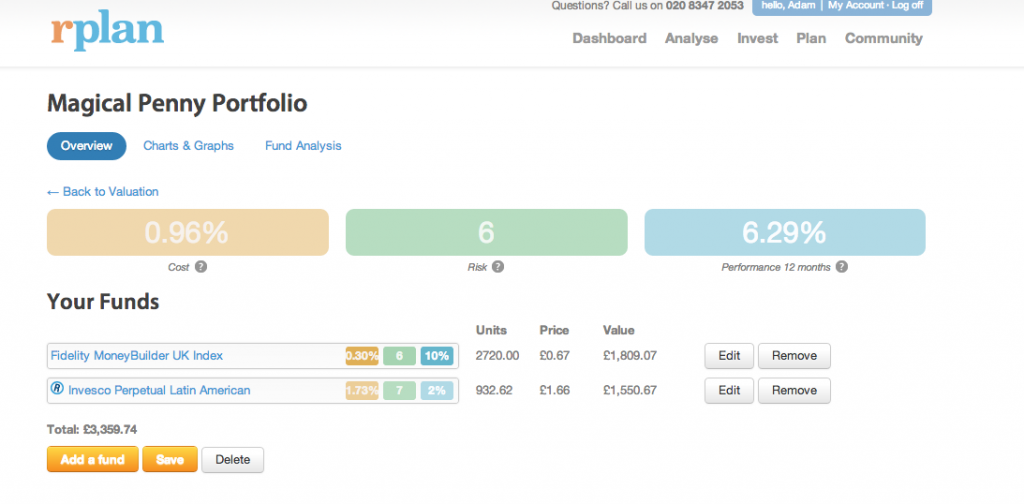
 rplan dashboard

Portfolio Overview

As you can see above, the main portfolio dashboard is centred around 3 key metrics, represented by the yellow, green and blue boxes in the centre of the page. These key metrics are paramount when it comes to portfolio management so it’s great to see rplan recognising this on their dashboard:

  1. Total Expense Ratio
  2. Risk
  3. Performance
Once you have added your funds to the portfolio (which we will get to later on), this dashboard is really all you need to look at to get a clear view of how your investments are doing.  Here’s why:

1. Total Expense Ratio

If you’ve ever tried building a portfolio before, working out the expense ratio of all the different funds can be tricky.  You don’t actually notice the fees being taken out -they come out of the fund’s value before you see them (!), but understanding expense ratios are important because, over time, they reduce your investment returns.
When I first started investing I was drawn to a fund that had a very low management fee. In fact, the fund’s key selling point was that it had the lowest management fee in it’s class on the market at 0.1%.

I felt pretty smug with my discovery.

But fund companies are notorious for hiding extra fees and charges.
I plugged in the fund into rPlan’s web-app and discovered the actual TOTAL expense ratio was 0.3%!
Imagine my surprise!
Looking back at the literature I could piece together where the extra charges were coming from, but rplan makes it easy – not only at a Fund level, but at a total portfolio level, to understand what the expense ratio was for my portfolio.
As a general rule I recommend keeping your total expense ratios below 1%, and with rplan’s tool, I can see my total expense ratio in the example above is 0.96%.

Result.

In the example above, my portfolio is only made up of 2 funds, but if I was doing this manually, working out the total expense ratio becomes more tricky as more funds are added to the mix.
But now that I know I can use rplan to optimise my portfolio it’s going to be easy to know how any changes in my funds will alter my expense ratio at a portfolio level.
Being able to keep track of expense ratios makes rPlan’s tool worth using, for that functionality alone! I haven’t seen anything like it on my investment platforms.

Suggested Improvements

If a portfolio is displaying unusually high expenses ratios, it would be great if the tool displayed a warning sign with an explanation about how expense ratios can cause a significant performance lag against benchmarks. Educating the consumer on expense ratios should be a priority. There’s a reason why rplan chose expense ratios as the first box on the dashboard, so flagging unusually expense portfolios would be hugely beneficial as many new investors would not have developed a frame of reference to know if the expense is higher or lower than others.


2. Risk

The second box on the dashboard is a risk score. As rplan explains, it’s really the Synthetic Risk and Reward Indicator (SRRI), which measures the volatility of the fund. A higher volatility means there is greater uncertainty about the size of the changes in a fund’s value. Getting your head around volatility is important to understand what you can expect to see if you were to check your portfolio valuations regularly. It is particularly important for older investors who may be intending to liquidate some or all of their holdings in the coming months as they approach retirement or another life-event that requires selling of investments.

For younger investors in an accumulation stage, volatility is arguably less important, but knowing your score (out of 7 on the dashboard) does allow you to prepare for the ups and downs of the stock market.

Bravo to rPlan for including it front and centre stage – investing is a psychological game, and recognising that volatility is a fact of life is very helpful.

Suggested Improvements

Only semantics really, but I much prefer ‘volatility’ over the word ‘risk’. Many new investors may be scared and search for low ‘risk’ funds, thus likely being directed away from funds with better performance over the long term.


3. Performance

This is the most important figure for most people, because knowing how your investments have performed is the main reason to check a portfolio. Other investment platforms I’ve used have included performance calculators but mostly at a fund level rather than a total portfolio level. That said, only having a 12 month indicator on the dashboard seems a little limiting. I would prefer a way to customise the dashboard to display more meaningful data over a longer period of time, and against a benchmark of my choice (like a FTSE index for example). The graphs and charts tab do offer more ways to look at performance but given how important a performance figure is to an investor, offering more options here on the main dashboard would be very helpful.

Suggested Improvements

Whilst I appreciate the need to keep the dashboard simple and clean, only including 12 month performance is not ideal. It is less meaningful to see performance over such a short time period, as investors typically have much longer investment horizons.


Selecting Funds
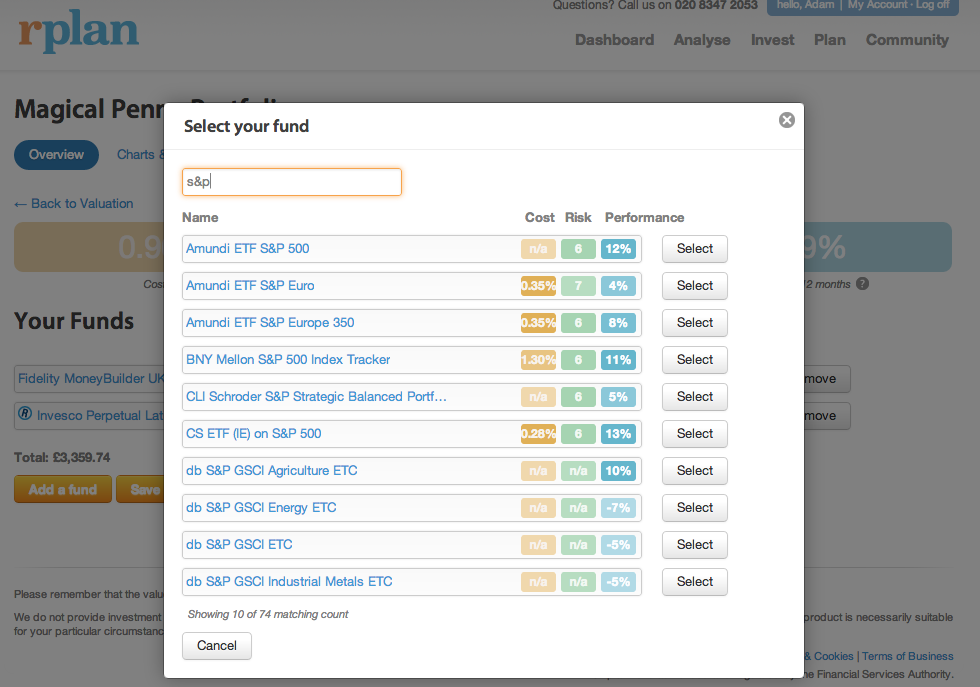
The portfolio tool is excellent at making sense of how different funds perform as a single portfolio, but, of course, the tool has to know which funds make up your portfolio.

To add funds to your portfolio is simple enough. After clicking ‘Add a Fund’ a search field is displayed and upon beginning to type the fund name, the tool begins searching and displaying possible funds which you can then select.

Crucially though, you have to know what you looking for.

rplan assumes you already have your funds at your investment company, and you are simply telling rplan what you currently have. Whilst there is a fund analysis tool that suggests similar funds to the ones you already have, I feel this initial fund search menu misses an opportunity to help investors find new funds that may be fit their needs. Being able to search across the key parameters of cost, risk and performance would be great, as well as other things like industry sector and type of fund (accumulation or distribution).

Once you have found your fund (assuming you know what you are looking for), rplan then asks for the number of units so it knows how much your holdings are for each fund. Once this is completed you are done, but I did notice a tiny glitch when I first tried adding in unit values: the field where you input the number of units does not respond well to commas. This is important because some investment platforms include commas on their summary pages. I imagine other users are going to do what I did, and copy and paste the unit value from their investment account into the unit field in the rplan tool. The commas were not recognised and meant the fund valuation was way off. Only after removing the commas did the tool correctly calculate the fund value. Making the field non-numerical character agnostic would be a safer bet and a better user experience. That said, maybe I’m the only one who is lazy and wanted to copy and paste my unit values!


What else is out there:

The tool that rplan has created is clearer than any I have seen before for analysing a portfolio that includes multiple funds. Until rplan came along, I was using Fidelity’s Portfolio X-Ray tool to do a similar job, but significantly it was very difficult  to look at performance and damn near impossible to keep tabs on expense ratios.

Here’s a screen shot from Fidelity’s Portfolio X-ray:
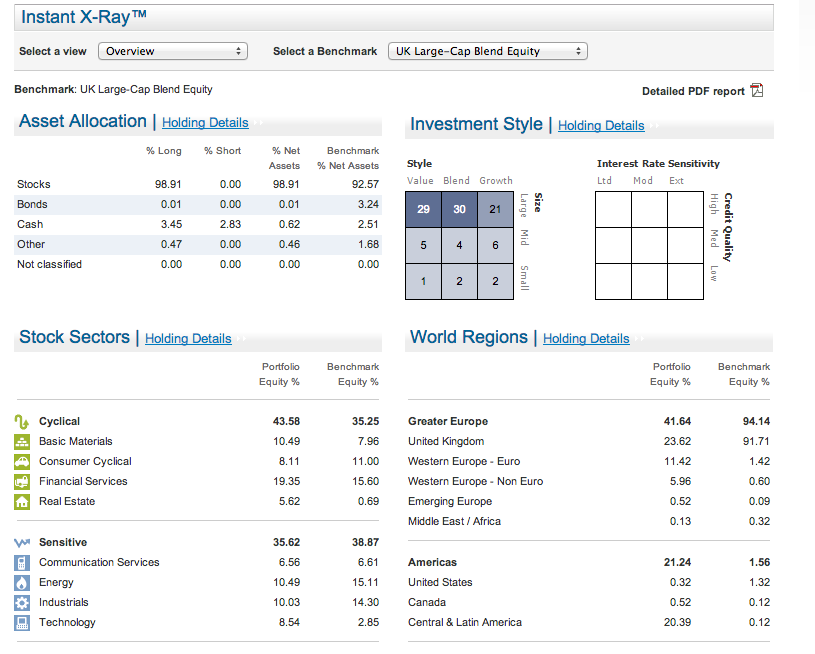
As you can see, this portfolio tool is interesting but it doesn’t highlight performance or expense ratios! But as it is integrated into my investing account, it is always accurate, automatically… which brings me onto the possibly fatal flaw in the rPlan tool…


Manual Updating – and some possible solutions

rplan’s tool, is just that – a tool to help you understand your portfolio (or simulated ones). It’s strength is that it focuses on the key metrics an investor needs and displays the data beautifully. But if my portfolio were to change, I would need to edit the number of units manually.

As someone who advocates regular monthly investing, that means a lot of typing each month as I work out how many more units I need to include for each of my funds.

Whilst the rplan tool is useful, I’m not sure I like the idea of this extra administrative chore every month.

The three options I can see are:

  1. Perhaps use the tool once or twice a year to double check I’m on track or when I’m evaluating rebalancing or changing my portfolio. This is less than ideal as the performance metrics will be off as the tool won’t know how long I have been in the market for each fund unit.
  2. Request that rplan integrate with investment companies for transaction data. This is less than ideal because these are rplan’s competitors based on their business model of fund brokerage (as well as searching and adding funds you own on other platforms, rplan provides it’s own brokerage service too. This is how it makes its money to be able to offer a free tool such as this dashboard!)
  3. 3) Add functionality to the tool to be able to input drip investing instructions so the tool knows how many fund units are being purchased each month based on a £ amount. This is my favourite solution but making this clear and simple to users would be the challenge.


In Closing

I’m thrilled I had a chance to review the rplan portfolio analysis tool. This is the best example of how the web is making investing more accessible to everyone.

The dashboard is clean, easy to read and provides the important numbers an investor needs to understand how a portfolio is performing. I wish I had this tool earlier, rather than having to do the calculations myself when aggregating my individual fund performance and expenses!

If the fund search tool is improved to make fund-shopping easier, and transaction data (real or simulated by a stated monthly contribution) can be included, this tool would be the best on the web for ensuring your investments are in line with your goals and intentions. Thank you rplan!


Want to find out more?

Visit rplan

I loved this video walk through of rplan’s tool

{ 1 comment }

Excellence in the Ordinary

by Magical Penny on November 2, 2012

Being ‘good with money’ isn’t something you can tick off a ‘To-do’ list.

It might sound obvious but how many times have you been ‘good’ by saving towards something, like a holiday, and then after the fact you go back to your ‘normal’ spending habits?

How many times have you tried to find some kind of balance after spending too much?

It’s pretty rare for me to here people around me lamenting on how much they had spent at the weekend. They often declare something like:

“I need to spend less…these last two months have been heavy”

Everyone has ‘heavy’ spending months from time to time but if you find yourself spending too much every month you may think the solution is to stop spending. But it’s not.

Here’s a few ideas to help you increase the balance of your  personal or business bank account, taking advantage of psychological tactics:

No spend days

One popular ‘trick’ people use to take control of their spending are ‘no spend days’. The idea is based on the observation that it’s too easy to go through a day spending small amounts here and there.

By forcing yourself to delay spending you become more conscious of your money habits and can tackle any problem areas in which you are spending a disproportionate amount.

It’s always a good idea to become more conscious about the things in which you are spending your pennies but the problem, however, is that no-spend days or their cousins, the no-spend weeks, are not sustainable.

Money Saving Cooking

The other day another friend was really pleased with himself as he recounted a recent victory: He had cut his grocery spending from £80 a week to £20 a week, with a simple ‘trick’ -writing a menu for himself and cooking at home every day.

It’s a great achievement
but just like the ‘no spend days’ the real test will be how long he can maintain this amazing cost saving in the coming weeks.

Binge Saving

Once you get into the mindset its relatively easy to ‘binge-save’. to pour every last penny into your business savings account . As your savings begin to grow you can feel the momentum and you are encouraged to save even more until you find yourself with an impressive nest-egg.

So far so good.

But as with most binges, there follows the purge…

Don’t misunderstand me – looking for ways to cut costs or making a declaration that you will reduce your spending are both great -it means you have more money to spend on other things.

Yet what most people miss is that if cutting costs makes you feel like you’re depriving yourself, then sooner or later you’ll, at best,want to return to ‘normal’, or, at worst, start spending extravagantly to make up for lost time.

It’s easier said than done but the real ‘trick’ to money is making sure you’re ‘normal’ spending is at a level that is less than you earn. It is not what you save over a week or a month, it is what you save over a year and ultimately over a life-time that really matters.

“We are what we repeatedly do. Excellence, therefore, is not an act, but a habit.”
– Aristotle

You don’t have to be perfect -just be as smart as you can on the little things (as excellent as you can be in the ordinary), automate the big savings goals and then:

Get on with your life!

That way, it doesn’t matter how much you spent last weekend.

{ 0 comments }

Take the stress out of sending a parcel to Australia

by Magical Penny on October 26, 2012

I’m fortunate to have had the opportunity to make friends with people from around the world and on occasion I’ve wanted to send them things through the post (despite my love of online communication nothing trumps getting something real through the letter box).

You probably already know that sending a parcel overseas isn’t always straight forward – making sure you have everything from shipping labels to shipping documents properly prepared can be a bit of a nightmare at times. The good news is that many online courier services now do most of the hard work for you, providing the tools you need to customise the details of your delivery without asking you to be an expert in international shipping first.

Even so, knowing a little about the key issues that can delay a delivery will always put you in a stronger position when you need to send a parcel to Australia or any other part of the world…something I’ve been looking into now that my little sister is in Australia!

First of all, if your parcel is being delivered within the EU then the potential problems you’ll face are far fewer than those can arise with overseas deliveries.

Deliveries outside of the EU will likely require customs documentation detailing precisely what is being sent. Deliveries outside of the EU are also likely to be subject to import duties as set by the destination country. Your courier should be able to provide full assistance and clarification here without too much fuss.

It is also worth bearing in mind that the further your parcel needs to travel the more it will be handled

International couriers operate on something called a “hub and spoke” model – meaning that deliveries are moved through a series of sorting depots as they progress towards their destination. Understanding this is important because the more your parcel is handled (being loaded off and onto various vehicles) the more chance there is of the contents becoming damaged. Preparing your package adequately before it is collected will save you a great deal of frustration further down the line. Use a sufficiently strong box, consider bubble wrap (particularly if your item is delicate) and secure the parcel with at least 2 layers of tape.

No matter what you’re sending, you should find that your courier should provide helpful tips and information that should make getting the most out of their services. It’s particularly worth asking about your options because there may be ways to save money, particularly if you do not have a time-limit. Whenever you find yourself unsure about any aspect of sending your parcel, your first port of call should be with your courier.

{ 0 comments }

As we enter into the final financial quarter of 2012, we appear to be approaching something of a watershed for the global economy.

The words floating amongst all today’s financial market analysis highlights three significant events that may impact on trading during the coming months, as the potential for heavy and sustained periods of austerity threatens to deter all but the most daring of investors.


In specific terms, it is the impending presidential election in the U.S., the federal governments’ fiscal cliff and the continuing eurozone crisis that will make their presence felt over the course of the next six months and beyond. This is creating a complex and diverse series of factors for financial traders to consider, and forcing many to hedge their investments in a period of calm before the inevitable storm.


The Financial Market Factors: How Will they Influence Trading?


With this in mind, how will these three independent factors impact on the financial market and individual traders? Consider the following: –


  • The Presidential Election: As the U.S. Presidential elections reach their long awaited conclusion, the landscape for financial traders is becoming increasingly blurred. The recently televised debate between the two candidates only served to create a heightened sense of caution within the markets, as the race drew ever closer to ensure that predicting a winner is almost impossible. The result will have a significant impact on the performance of the U.S. markets, and many investors are choosing to hedge their assets until there has been a definitive resolution.



 

  • The Eurozone Crisis: The most complex of all the issues currently effecting the financial markets, the eurozone crisis is reaching a critical point in time. With bailout discussions between Germany and Greece continuing, investors are monitoring the situation closely to see whether the Euro can continue to grow and gain strength. As an aside, the IMF (International Monetary Fund) have warned against the implementation of strict austerity measures for nations such as Greece and Spain, as this could damage any potential for future economic recovery.


The Fiscal Cliff: Although the U.S. governments fiscal cliff will not make its presence felt until the proposed budget cuts are implemented on the 1st of January, the potential consequences are causing huge trepidation and anxiety among business owners, tax payers and financial traders alike. This is also prompting significant levels of caution among astute traders, as many are looking to consolidate their market position and protect their investment assets whilst trading derivatives in the financial market. With this in mind, the final financial quarter of 2012 could be an extremely nervous time for traders, especially those who have less experience within the market.

 It remains the objective of many investors to seek to find a comprehensive sources of information to open up investment options.

{ 0 comments }

Banking for Expats in the UAE

by Magical Penny on October 12, 2012


The shimmering steel beacon of Dubai often beckons to business travellers.

The region has a myriad of financial possibilities for entrepreneurial Britons, especially in the capital of Abu Dhabi, arguably the political and economic heart of the United Arab Emirates. Certainly I know a few friends who have moved to Dubai to make their magical pennies grow!

This city is also a big draw-card for Britons branching out with overseas business operations.

However, there are important banking differences between Britain and the UAE. And all business travellers should know about them, before embarking on the adventure of relocation.

Before Getting On the Plane

It’s a good idea to bank with a British institution that has a branch presence at the chosen destination. Plenty of banks from home do have offices in central Abu Dhabi or Dubai: this will be a godsend when trying to get urgent transactions attended to, in the early days.
It’s also important to compare several UAE banks for the best deals in regards to fees, a low interest rate and benefits like an overdraft. While HSBC current accounts are a safe bet, the fees and quality of service will vary quite markedly between different UAE bank accounts, so it pays to get the best deal before boarding the plane.

Getting A UAE Current Account

After touching down, one of the initial shocks to the senses will be the new currency. The Dirham in the UAE is abbreviated to AED or Dhs. Denominations include: one thousand, five hundred, two hundred, one hundred, fifty, twenty, ten and five notes. Coins in the currency come in a one dirham, fifty and a quarter. To get the most accurate and up to date exchange rate, download a free currency converter app for iPhone and Android. This will give up to the minute exchange rates. In the early days, this can help with the teething problems of adjusting to the new currency and avoid overzealous spending.
Certain international banks such as HSBC and many others offer offshore accounts. This can be an effective and streamlined way for expats to manage their money while in the UAE.
Opening a UAE current account is relatively simple, but you will have to bear in mind that the account will remain in a half-active state until a valid visa is sighted and verified by the institution. During this half-active stage most functions like making cash or cheque deposits are not permitted. However, it is permitted to make credit card transactions in the meantime, before the visa is sorted out: just be wary of getting too slap-happy with the plastic, as British banks will charge international fees for doing so.

Old Fashioned Banking

The level of service for online facilities for UAE banks vary wildly. Generally, the preferred method to make transactions is in person. Also remember that banks follow different times from the homeland: UAE opening times go from 8 am to 2 pm weekdays apart from Friday, when branches are closed. However, some of the larger and central banks will be open for longer hours, so it pays to get online to check. All in all, there are plenty of well-known benefits for expats wanting to move to the UAE, such as no tax and high income expectancy. But before starting your new life under Dubai’s sun you will have to be aware of the stark differences in the business environment: as you get to know more about these, a plethora of opportunities will open up in front of you.

{ 0 comments }

Paying off debt or saving?

by Magical Penny on October 4, 2012

Focus is important when it comes to growing your pennies. But how do you stay focused on savings goals that typically require you to stay the course for longer than a year, like a newer or a deposit for a house?

Debt + Other financial goals = Wrong?

Firstly I’d like to address the controversy: For some, having any other financial goal when you still have debt is the foolish thing to do. Debt is costly, risky and if you’re struggling to keep focused when paying off debt there’s no room in a budget for other financial goals.


Some personal finance personalities say that in order to make progress with your debt you need to focus on it completely –focus intensely on paying off every last penny as quickly as possible.


But, is this the right strategy?

Certainly from a purely mathematical perspective most debts are costly and it’s unlikely that any money saved is earning more interest than the interest paid on a debt. By saving the money instead of paying off debt the choice comes at a cost. However, you should consider beginning to save for medium term goals like a house deposit even if you do have debt. Whilst you definitely should be focused on paying off your debt, allocating some of your pennies each month to medium term goals has many benefits in helping you stay focused on growing your pennies.

Staying Focused on Medium-term Goals


Extra Emergency Fund

Before you begin paying off debt it is very wise to build up a small emergency fund to stop you having to resort to more debt in the event of a financial problem. But if you’re saving for medium term goals. those savings can act as an extra fund to help bolster your emergency pot of pennies, giving you more security (until you spend those medium-term savings of course).

For me my house deposit savings are acting as an emergency fund because I do not plan to buy a house for another few years. I’m still focused on the fund though:  I found that it was easy to focus on saving because I knew that every penny saved has a double purpose: the potential to help me in an emergence, and as the first steps towards my medium term goal of owning a house.

Medium-Term  Becomes TODAY Quicker Than You Might Think

Sometimes ‘medium-term goals’ quickly become today’s needs: your car might break down beyond repair or an amazing opportunity might come up unexpectedly.  I hate debt as much as the next personal finance blogger but by making a start on your medium term goals today rather than waiting to pay off all debt you will have flexibility: for example you could replace your car take advantage of an opportunity that you might not have otherwise have been able to if you had sent all your extra pennies to tackle your debt. That said, remember to find the right balance and don’t leave your debts completely unpaid for fear of losing your flexibility because there are benefits to being debt free too!

Psychological Boost

Saving for medium term goals has an immediate psychological value: it makes your wishes and dream more real. You may not have a house, but you can work towards having the money for 1% of it, then 2%; You may not be on your round-the-world adventure but you’ll soon have 5% of what you need sitting in a bank account. A few fledgling medium-term savings accounts are amazing at helping you maintain your focus because they give you direction and vision. They can even help you keep focused on paying off your debt because the medium-term saving accounts have begun to make your future debt-free life seem more real. And you know that the sooner you pay off your debt, the sooner you can grow your medium-term savings accounts further!

Ultimately saving for medium term goals is the easiest way to stay focused on growing your pennies:  Thinking along this time horizon can help you remain focused on paying off the debt that is getting in the way of your dreams. It can also make the idea of growing your pennies seem more worthwhile because the future that you are saving for is so soon: medium term savings are only 1-5 years away. Yes, it is true that it would be cheaper to put every penny towards your debt and then start from scratch on medium term goals, but this underestimates the psychology of money management.

Am I wrong? Should you pay off all of your debts before saving for anything else?

Thankfully I’ve never had debt apart from student loans so I’ve not felt the burden of debt yet I have felt what it’s like to begin saving for medium term things and know how great it feels to gain traction on my goals.

What are saving for in the next 1 to 5 years and what helps you stay focused? Let me know in the comments!

{ 9 comments }

A Fresh Start | Do you have a plan for your money?

by Magical Penny on October 3, 2012

It’s the start of the month and it’s likely your bank account is looking better now than it’s going to look all month. But do you have a plan for your money?

The start of the month can feel good because it’s when a lot of people get paid their monthly salary. It’s a fresh month and a fresh start. You might have intentions to make this month better than last month in terms of making your money last, or you might even be starting to think about Christmas – it will be here before we know it!

But how can you make your good financial intentions future-proof for the months and years ahead?

You should ask yourself these two questions:

1) Have you asked your bank to set up automatic transfers from your day-to-day account to your savings?

Here’s the why:

You might be feeling confident about  your income or the money in your account today, but life can change fast and our state of mind can change even quicker. Good intentions are often short-lived. Why not take the will-power out of the equation and set up some automated electronic transfers?

Here’s how to do it:

If you have online banking it’s as easy as setting up a ‘standing order’ (if you’re in the UK) from your current account to your savings account. Setting up an automated transfer today will help you emotionally disconnect from the process of trying to save money so you’ll be stashing it away for your long-term future.

If you don’t have online banking then it is well worth a quick visit to your bank to set it up – get it set up for shortly after you’ve been paid so you are making a commitment to save every month, not just when you have money left over (as if that ever happens!).

What if you don’t have enough money to set up automatic transfers?

If you’ve living paycheque to paycheque, you might not feel you can afford to save anything each month because there’s hardly any money at the START of the month! In this case, it’s time for you get intense to give yourself a much-needed ‘buffer’ of money in your account.

You can do this by working extra hours, cutting back on your spending further, or consider selling any valuable items you might have lying around. With gold prices so high right now, it could be worth selling any old gold jewelery or items you have in your house to give you that much needed boost in funds. You can get money for gold with 62 Days, so in two months time your money plan could be looking much better funded!


The second question everyone should ask themselves is:


2) Have you thought consciously about your spending and created a ‘spending plan’ ?

Here’s the why:

It’s easy to tell yourself that you want to spend less on something you enjoy, but if you don’t write it down and put some thought into what you are spending money on, then you might end up spending more than you think. Having a ‘spending plan’ might seem restrictive but once you’ve tried it you’ll find it actually is immensely freeing –you can spend money without guilt as you know you’ve got everything covered (especially if you’re saving consistently and automatically at the start of each month).

Here’s how to do it:

Think ahead into October and make a list of everything you need or would like to spend money on and try to stick to it.  You definitely won’t stick to it 100% but doing so will raise your consciousness about your spending. And don’t try to make a ‘perfect’ list – make it realistic.  Take the time to *think* about what you’d like to spend your pennies on and you are likely to make some wiser choices this month.

Once you’ve got your spending plan you might even find yourself being able to afford more things than ever before!

Don’t let your spending just ‘happen’ to you.  Rather, take the time to consciously plan how you can construct your best life with the funds you have available.

The start of the month, right after pay-day can feel great but make sure you lay the groundwork to prosper throughout the year!

It’s never as good as today to make that fresh start with your money! Good luck! 🙂

{ 1 comment }