Insurance: Is It Worth It?

by Magical Penny on April 1, 2019

There are so many different types of insurance out there that there’s a good chance you’ve considered taking out a policy or two.

But is insurance worth it?

You’ll always get someone arguing that you could put the premium away in a savings account each month and have more than enough to cover whatever claims you eventually make down the line. But is this really the case?

Well, perhaps it could be if you are only covering low value goods. But you never know when disaster might strike and you could find yourself on the receiving end of a large bill to replace or repair whatever it may be that you’ve insured. When it comes down to it, taking out insurance is almost always a good idea. Let’s take a moment to take a further look into what insurance actually is and a few different policies you might want to consider!

What Is Insurance?

Insurance is a policy that can help to protect you against risks. You will take out an agreement with an insurance provider. You will agree to pay a set monthly premium and in return they guarantee that they will repair, replace, or offer some sort of monetary pay out for whatever it is that you may have insured with them should something bad happen to it. This means that if something does go wrong, you won’t have to pay the full price to put it right or make things better.

Choosing the Right Insurance

When you take out insurance, it’s important that you don’t simply take out a policy with the first provider you come across. Instead, you need to scour the market for the best deal. Generally speaking, you will achieve this most easily if you make use of a comparison site. This will compare numerous providers and let you know which policies are cheapest. If you are set on taking a policy out with a favoured or preferred provider, you can always ask them to price match a lower offer you’ve seen. They may do this to secure your custom.

Car Insurance

Certain types of insurance are a legal essential. If you want to drive a car, you legally have to have car insurance before taking to public roads. This is because when you drive a car, you are constantly in a situation where you could damage someone else’s property as well as your own. If you are in a car incident, you can damage someone else’s car or property at the same time as damaging your own. Having car insurance means that the other party can make a claim that your insurance provider will pay out for if you damage something of theirs.

Home Insurance

Home insurance isn’t always a legal necessity, but it is something that you should seriously consider. There are various different policies out there for different types of homes, so make sure you know what you’re looking for first. If you are renting a property and don’t own it, you don’t really need to have home insurance. Your landlord should take care of this. Instead, you should look at contents insurance, which covers the contents of your home – the things that belong to you. If you live in a condominium, you may need specialist condo master insurance. This will be taken out and shared by everyone in the condo complex. If you live in a protected or listed building, you may also need specialist insurance. When taking out a policy, try to protect your home against as many potential problems as possible. Some policies will cover specific things (such as flooding or natural disaster), while others won’t. If you want to cut the cost of your premium, make sure to be logical and reasonable. If you live in an area that’s prone to flooding, you might not want to cut parts of your policy that protect your home against water damage.

Pet Insurance

Pet insurance, again, isn’t a legal requirement. But it’s something that every pet owner should take out. Veterinary bills can skyrocket, even for the most seemingly small procedures or short-term medication. When you have a pet, they become a part of the family and you also take on full responsibility for their health, happiness, and overall well being. You need to provide them with the best that you can. You also don’t want to find yourself in a situation where you are having to take out loans or dig into debt in order to be able to provide your pet with the care 

that they need following an unexpected illness or accident. If you don’t have insurance and are unable to get together the funds to cover treatment or medicine, you may find yourself in the difficult situation of deciding to give your pet up for adoption to someone who can afford the treatment, or even having to put your pet to sleep.

Travel Insurance

Travel insurance can cover so much more than your belongings while you are away. It’s really is a must if you’re heading away on a trip – mainly because it can cover medical costs if you were to injure yourself or become ill overseas.

Phone Insurance

Phones aren’t the most expensive thing you are likely to have. But repairs and replacements can still be an expensive purchase. The price of smartphones is constantly on the rise and they seem to be simultaneously getting more and more fragile. You can invest in a high-quality case, which will help to protect your phone if it is dropped. But you can never guarantee you won’t run into problems.

So, consider taking out phone insurance against loss, damage, and theft. This is particularly pertinent if you are still paying off the cost of your phone on a contract. You don’t want to lose or break your phone, only to have to keep paying for it for the rest of the duration of your contract!

As you can see, taking out insurance is generally a good idea and for the best in the long run. Try not to count on good luck. Back yourself up as best possible!

{ 0 comments }

The Benefits of Going Into Property Development

by Magical Penny on April 1, 2019

stamp duty change 2016Property development is one of those things that everybody is trying to get into.

Property is one of the most secure investments that you can make, and if you play your cards right, you’re pretty much guaranteed to see big returns. Of course, you need to have the right skills (and enough cash saved up) to pull it off, but if you can make this your primary way of earning some money, you’ll be reaping the rewards. We’ve put together some reasons why you should go into property development!

You can make a lot of money, quickly

Most people who go into property development complete a given project within 6 to 12 months, depending on the scale of the property, and the work that needs to be done. Bigger properties can take a number of years, but if you’re looking to get a quick return and you have the time to put into a smaller property, you can get your cash back within a matter of months. If you develop one property a year, you’ll also be able to avoid big tax prices, meaning that you can walk away with a bigger sum for your project. You’ll have to spend the cash if you want to see the results, but it’s certainly worthwhile.

You can add your personality to a property

The properties that you’ll be looking at buying will be rundown, neglected, and in need of some TLC. There is nothing more rewarding than giving that property a new lease of life, and returning it to its former glory. Not only this, but you can add your own stamp onto it, and create something of a work of art within the house. Unfortunately, a lot of developers just throw the minimum amount of cash at a property to make it liveable, but if you put a bit more time and care in, then you’ll see the aesthetic – and financial – results. Look into these must know tips for property development if you want to find out more.

You can do the work yourself

The best part about going into property development is that you don’t always need to hire people to do the jobs for you. Sure, you may not be very good at plastering and you’ll have to get builders in to do these kinds of things, but basic jobs like painting are pretty easy to do yourself. If you’ve got some good knowledge of DIY and building, you’re in an even better position here, so see what you can do yourself to cut back on the costs. This will really influence how much cash you need to spend on a property, with builders costs being quite high across the board. If you’ve got the skills, then it’s a good idea!

So, if you want to get big sums of cash from property development, and you have the money to invest in your first project, then this could be your next big earner. Sure, you need to be careful and having the right skills is key, but all in all, you could be onto a winner!

{ 0 comments }

Jumping Into A New Family Business

by Magical Penny on March 26, 2019

When we’re having to deal with the morning commute, perhaps stuck in traffic, functioning on only six hours of sleep and with the rain pouring down, it’s not uncommon for many of us to desire a simple resignation to jump into that home project you have been considering for some time. Jumping into your own business might be something you’ve considered for a while. Perhaps you have some expertise in it. Maybe you wish to establish something within your own field, or jump to something completely new, such as running a small farm.

This move can be a worrying one, but also an extremely exciting one depending on your point of view. Looking forward to the future and trying to figure out how to progress is often the first difficulty, even before you put plans into place. To keep this post versatile we’re going to try and keep things variably applicable to a range of family businesses you may wish to open, and to give you some wonderful planning advice for the future in this vein.

So let us get started:

investingKnow Your Purpose

Knowing your purpose for moving forward can help you make confident decisions. What is the intent of your business? How much will it cost to open and register? What revenue will you need to generate by a certain date in order to continue operating correctly? What starting funds can you ascertain to begin and setup? Do you have any form of outside help, or how might you pitch this to an angel investor? Do you have any prototypes of your product or service? Leaving nothing to chance or open ended can help you draw up your business battle plan more effectively, and this can prevent you from jumping in with both feet first and putting your family’s future on the line to begin with.

Invest Wisely

Invest wisely in the equipment and treating your business space as it should be. It might be that instead of purchasing equipment outright you might go for a payment plan option, such as tractor finance tiers, helping your long-term cash flow survive against the odds of starting a business with long-term results, especially within an interest as patience-driven as farming. Investing wisely in your location, in outfitting your firm, in the staff options and potential for growth can help you make the best financial decisions, akin to that someone running a startup may have to make.

Don’t Quit The Day Job

Of course, before taking this decision to push forward, you need some form of financial reliability. For example, before opening your bakery for good and putting the plans in place in your spare time, it might be worth working a full day at your current employment term. This can help you position yourself in the best manner possible before finally pulling the lever on the entire operation.

With these simple tips, you’re likely to lightly step, wisely, into a family business.

{ 0 comments }

Making The Most Of Buy-To-Let

by Magical Penny on March 18, 2019

If you are starting to think about buy-to-let and you think you might soon be in a position to do so, then it can be a very exciting time in your life.

Of course, you will find that there is still plenty you need to do in order to make it all work out, and there might be a few hiccoughs along the way, but as long as you are happy to face those head on you should find that you are more likely to succeed. Buy-to-let can be very lucrative, and if you do it right you should find that you are able to really turn your life around with this method of investment. Of course, it might just be an extra addendum to your income, which is fine too. In either case, you will want to know how you can expect to make the most of it, and that is what we are going to look at in this article.

As long as you are keen to follow some of the advice in this post, you will find that you can make much more of buy-to-let, hopefully to the point that you will be able to completely change your life with it. Let’s take a look at some of the things you might want to consider on that front.

The Quality Of The Property Is Everything

First of all, you need to make sure that you are aware of how to find good quality property, as the quality of the property that you are using is going to be the most important thing of all. That means appreciating what it is that actually makes something a good buy, and in particular what will make it a likely popular place for tenants to want to rent out. Understanding and appreciating how to find a good property is quite difficult and takes some time, but with the right comprehension you should find that it can be made significantly easier.

One of the first things to look into is who actually built the house. If it is a new build, or relatively new, then you can easily find out who was behind it. If it was one of the larger house builders like Redrow Homes, then you know that you are in luck, as it is likely that you won’t come across too many issues with the property, if any at all. This is a great way of ensuring quality from the very start, and it is therefore something you should always look into. Of course, it is not always the case that you will be looking at new properties, and when you are not it is much less about who built the property than what it has to offer. In fact, in either case, you should be focusing mostly on what it has to offer.

Determining the quality of a property is a matter of appreciating its overall usefulness, attractiveness, and likely enjoyment of living in it. That takes into account everything from the surrounding area to the shape and size of the property, to how resistant it is to different kinds of weather. All of this is worth taking a deeper look into, and we will do so later for some of it, but for now i is worth bearing in mind simply that you need to spend a long time getting to understand the actual quality of the properties you are looking at. If you can do that, you should find that you are able to much more easily determine what kinds of properties to go for, and which you might as well avoid altogether.

Researching the Market

If there is anything which is as important as appreciating the quality of the individual property, it is understanding the property market. You need to spend a long time researching the market before you make any big decisions, as not doing so can mean that you accidentally land yourself in some deep trouble, or at least that you might not end up with the best deal that you could possibly get your hands on. So when it comes to researching the market, what are some of the factors that you should mostly be looking out for, and where should you be getting your information from?

First of all, you will want to look into the specific buy-to-let opportunities in the marketplace and see whether it is really the kind of investment that you want to spend time and money on. It might be that it was not quite what you thought it was going to be, or that the marketplace is not currently in the position you were hoping for, in which case you will need to make sure that you are considering whatever other options might be available to you. Never feel like you are tied down to the one form of investment when there are so many others out there.

The other main thing that you want to keep your eye on, of course, is house prices. Appreciating the house prices in the area and at the current time ensures that you are going to get the best deal you can – but it is also often an indicator that you should wait for the time being, until it is a better time to invest. Often just by waiting five years you can ultimately make much more of your money, and usually you won’t even have to wait that long for it to be worthwhile, so make sure that you are considering this as best as you can. It’s worth looking not just at the present, but at the underlying trends going back and forward to appreciate where the market currently is likely to be. The more you understand here, the better.

As you can see, this kind of research is hugely important, but alone it is not quite enough to really make the most of a buy-to-let. You’ll also need to think about who it is who is likely to want to rent out your property once you have bought it.

Knowing Your Customer

Probably one of the most common mistakes that people make on their first buy-to-let is that they fail to think about who is going to be renting out the property in question. This is such an essential thing that once you think about it, it becomes clear that it is something you will want to consider. After all, it is this individual or couple – or family – who are going to be paying you money each month for staying in the property. If you can know who they are going to be as accurately as possible, you can then have their image in your mind as you research properties. That will be much more likely to result in a successful buying of property, as you will have more luck in then finding someone to rent it out.

So how do you get to know your potential future customer? One of the best ways is to look, again, at the market for the area in which you are operating. What you want to do here is to take a look at the demographics of the people who tend to rent out homes in this area, and then see if you can find any kind of trends, or at least a kind of underlying demographic that you can focus on. In some cases, for instance, a town might be particularly prone to new families getting set up, whereas at other times it might be professional middle-aged couples looking for a home. Whatever it might turn out to be, you want to know about it, as it is going to ensure that you can not only find the right property which is likely to be popular, but also ensure that you can then decorate it and make it as attractive as possible to those kinds of people. If you can think of yourself like a business with a target customer and a certain way of approaching that customer, you will find that you can have much more success with the whole venture.

Finding A Promising Area

We all know, of course, just how important location is in the choosing of a property. It is one of the major determiners of value, but it’s also a hugely trustworthy indicator of how enjoyable it is to live in a specific property too. You need to therefore ensure that you are doing as much as you can to find a property in an area which seems promising to live in. There are many things that you might want to look out for, and once you have spent some time doing so you will start to get a sense of what kind of signs mean that the area is likely to do well in the near future. If you can see that large businesses are starting to open up a branch in that area, for instance, then that is a good sign. If you know that investment is coming to a particular city, you also know that people will flock there. All of this is important, and will help you to determine what is a promising area to try and find property in.

{ 0 comments }

If you go online, there is a high chance that you will see so many stories of people earning themselves a small fortune from real estate. This can inspire you to take that next step yourself, but before you do, there are a couple of things that you need to be aware of.


Don’t Let your Emotions get in the Way

When you buy your first home, you will probably listen to your heart more than your head. This is great because you are going to be living in that home for years to come. When it comes to your investment property however, you should really be doing the opposite. You need to think as logically as possible and you also need to make sure that your emotions do not affect your decision. Think about it as a business transaction, and concentrate on your bottom line.

Do your Research

Depending on the type of tenants you want to target, you need to do your research before you buy your first property. Make sure that the property is situated in a location that will attract your target audience and also make sure that they are able to afford the rent. By doing your research, you can also find out what your prospective clients like and don’t like as well, and this will help you to retain them for much longer periods of time.

Secure your Down Payment

You will probably need to put at least 20% down for your first investment property. This is because mortgage insurance cannot be applied to an investment property, and on top of this, they will also have strict approval regulations as well. You might even need to renovate the property as well because if you don’t then this could deter tenants.

Calculate your Expenses and Profits


There is no harm in being a tiny bit paranoid when it comes to your property. You need to consider every single detail beforehand and you also need to work out how much money you have right now as well. When you have done this, you can then calculate how much it is going to cost to renovate the property and to get it up to a high standard. Finally, work out how much profit you stand to make. Is this enough for you? Are you going to be able to afford property maintenance on top of this? If so then you have a good thing going. If this is your first time renting a property out to someone then it is a good idea for you to invest in a residential property management service as well, as they can help you to really get a great result out of your experience.

Low-Cost Properties

It doesn’t matter if you have a small fortune to buy your property with, because you should always try and buy a home at a low value to begin with. More people will be able to afford it, and it will also make you appeal to a much wider audience.


{ 0 comments }

Do You Know How Much You Need To Retire?

by Magical Penny on March 5, 2019

At the start of a new year, (or at any other time!) it’s natural to reassess what we want out of life and how to make it happen.

Some goals, like losing weight, are easy to grasp, even if achieving them requires some dedication or will-power! But there are other things like ‘sorting a pension’ that we know we should be doing, but the goal is more abstract and hard to pin down.

We know there will come a point in our lives when we can no longer work, and we will rely on our life-savings to provide an income in our old age.

But how much should we be saving?

It’s a difficult question but one that Profile Pension’s new calculator is here to help answer.

According to a recent study by the Pension and Lifetime Savings Association (PLSA), 80% of us are confused about whether we’re on track for retirement.

Personally, I knew I should be saving for my retirement and I started contributing to a pension with my first job after university, but I didn’t know how much I really needed to save and just picked a figure out of thin air and promised myself I would look into it in the future. Maybe you have done the same?

If you’re unsure how much you need for retirement be sure to read on…

You Might Need More Than The State Pension

In the UK, the state pension provides a basic level of income in retirement (now from age 67 but it will increase in future years). There have been lots of changes to the state pension in recent years but moving forward the full new State Pension is currently £164.35 per week.

It’s important to note that you have fewer than 35 qualifying years (if you took any time off work and didn’t pay National Insurance contributions) then your state pension will be reduced but you might be able to top up by paying voluntary National Insurance contributions. More information on this can be found on the gov.uk website.

Could you live on £164 a week?

Even if you have a full National Insurance record and are entitled to the full State Pension, could you live on £164 a week? For most of us, that will be not be enough to provide a sufficient income to live the lifestyle we want in retirement so we will need to set up our own private pensions and/or contribute to any pension policies we get through our employment.

How To Work Out What Is Needed

Retirement planning can be difficult because the destination is either so far away that it is hard to imagine what life might be like 30 or more years into the future, or retirement is approaching fast and the prospect of saving a huge nest-egg becomes too daunting, or simply impossible. But wherever you are in the journey, it is worth taking some time to think about how much you can save for the future.

Regardless of how far away retirement might be for you, getting an understanding of the numbers now, and how much you might need is incredibly powerful.

Once you have an idea of what you might need, you can start budgeting according to fund your future retirement.

So, how do you start?

Enter Profile Pensions’ Pension Calculator

I’m pleased to share a really helpful pension calculator created by Profile Pensions to guide you through thinking about what you might need for retirement.

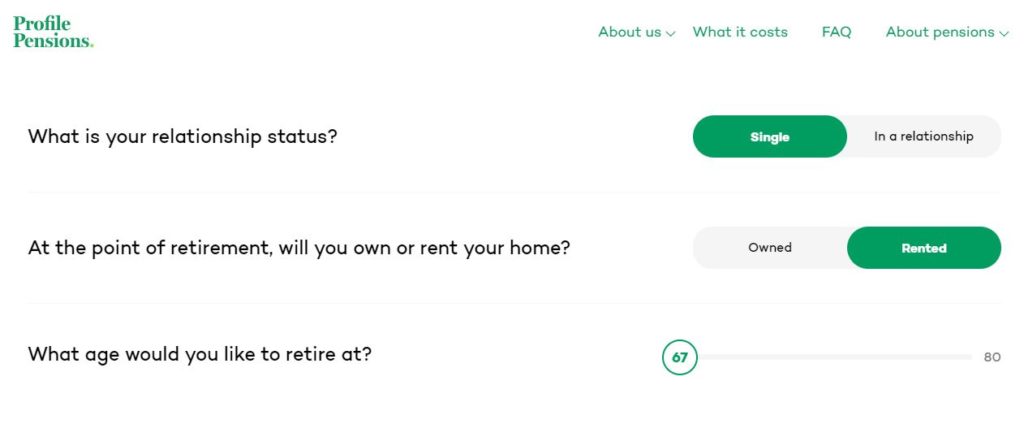
The calculator requires your answers to three basic questions:

  1. Your relationship status
  2. If you plan to own a home or rent in retirement
  3. The age you intend to retire

Don’t worry if you don’t know the answers, you can change them to see how your choices affect the final results.

Once you can answered the questions, the tool shows you how much income you might need in retirement, and then shows you how much total savings you need to have by your retirement age to generate that income.

When I used the tool, it told me that for a ‘Modest’ lifestyle, I would need a total pension of £157,000 at the point of retirement, and for a ‘Comfortable’ retirement, I would need a total pension of £525,000.

My Thoughts on the Calculator

The calculator is really simple to use and quickly provides a helpful idea of how much I needed the value of my pension pot to be for a modest and comfortable lifestyle in retirement.  The results were clearly displayed and certainly motivated me to increase my pension contributions a bit, so the calculator did its job of getting me to think about my current level of retirement saving.

However, the tool is only as good as the assumptions it uses, and the set assumptions don’t apply to everyone, so your requirements could be very different in reality. My advice would be to use the calculator as a starting point, not to find a definite answer. For a definite answer you might need to do some more advanced calculations in Excel or speak with a professional Financial Adviser for more detailed projections.

That said,  the simplicity of the calculator is helpful for getting started, though I do have two suggestions on my wishlist:

1. Turning A Pension Pot Into An Income


Unless you have a pension that promises you a certain income, like a teacher’s or a doctor’s pension that pays out a percentage of your salary for each year you’ve worked (known as a defined benefit pension), then it’s likely that you will have a pension policy that is simply a pot of money/investments that you can add to each month or each year and hopefully it grows over time based on the investments held within the pension (known as a defined contribution pension).

At retirement you then need to use that money in the pension to provide an income, some of which can be taken tax-free and the rest is taxable.

The calculator assumes you will use all of the money saved (with no tax-free cash taken) in the pension policy to buy an ‘annuity’, an insurance product where you pay a lump sum to an annuity provider who then promises to pay you an income until you die.

Annuities can be good for peace of mind, knowing you are not going to run out of money before you die, but the rates are typically lower than ever, meaning you have to pay a lot for the promise of a relatively low income.

For example, depending on your age and circumstances you could pay £100,000 to buy an income of £3,000 a year.  For many retirees the annuity option is not appealing as they prefer to take some of the money out of their pension pots to top up their income when needed, and leave the rest of their pension savings invested so it can hopefully continue to grow.

This is known as ‘pension drawdown’.

It is a less certain way of providing an income in retirement because the money could run out if the investments don’t do well or the withdrawals are too high (!), but it does provide more flexibility in how much income is taken each year, and if the investments do well, can result in a higher income from a smaller pension pot – which can be reassuring to those who have not managed to save much for their retirement yet and don’t think they can reach their retirement goal.

My ideal pension calculator would therefore include both the annuity option (which the calculator currently is based on), and a drawdown option which, if you are willing to accept more uncertainty, could mean a smaller pension pot target.

2. How much do I need to save to reach the pension goal?

The calculator shows how much I need my pension to be worth but does not show how to get there – how much do I need to save each month and how much do I need the underlying investments to grow by to reach my income goal?

My ideal calculator would have both the final number (which the current calculator has) and a monthly or annual amount for what is needed to achieve the final number. This savings number would be calculated using various assumptions including investment growth rate and charges and how much these things affects the final result. By providing both sets of numbers, the final amount and the estimated monthly contribution required, the calculator could help answer more complicated questions like is it worth working more and saving less, or vice versa.  For example, this could help people decide if working for one extra year could mean not having to find so much in the monthly budget to save for retirement.

So How Much Is Enough?

I encourage you to use the calculator and take the answers it provides to help you think more about what you need to save for your golden years.

Once you’ve had a go, don’t be discouraged if the number is much higher than you think. When you invest in a pension, most of the time the money doesn’t sit in cash, but rather, it goes into investments that should hopefully grow faster than inflation, helping you to reach your retirement goal. Also, the amount of income you need is very personal and everyone will have different needs and aspirations for their retirement.

You may think you will need a similar income in retirement to what you earn now, or even more if you want to travel the world in luxury in your golden years. If so, then get saving hard. But perhaps you may crave a simple, low cost life that doesn’t require the latest fashions and daily coffee shop lattes, so your retirement saving goal may be less.

You should also consider that spending needs rarely stay the same over the years. For many, the early years of retirement means higher spending as they have the time to travel and do all the things they never had time to do during their working years. This ‘spendy’ period then often transitions to a quieter, more frugal time as life slows down – perhaps health or mobility issues curtail the amount of travel that’s possible, or the idea of staying comfortable at home has a bigger appeal than travelling, with creature comforts at home being more preferable to lavish hotels and room service. Then, finally, for an unlucky some, costs can start of go up again in later retirement if long-term care is needed.

The Power of Planning

By taking the time to assess your retirement savings, the exercise can either provide the peace of mind of knowing that you’re on track or it can light a fire within you to change the trajectory of your financial life. You may even wish to over-save so you can leave a financial legacy to your family. Hopefully this calculator will help you dream and realise how much is possible for you.

Happy planning!

This post is a collaboration with Profile Pensions whose mission is to help everyone in the UK better understand their pension(s), allowing them to be more informed and ultimately better off in retirement. They provide impartial, expert and ongoing pension advice. Capital at risk.

{ 0 comments }

4 Places To Turn For Help When You’re In Debt

by Magical Penny on March 4, 2019

Using credit cards

When you’re buried under a mountain of debt, it can feel incredibly lonely.

Often, people hide their money worries from friends and family because they’re embarrassed or they’re worried that people will judge them in some way. That means you’re taking the entire burden yourself and that’s not a good way to deal with debt problems. But the thing is, you don’t have to deal with it alone because there are plenty of different places that you can turn. These are the best places to look for help when you’re in a lot of debt.

Your Creditors

The first place to start is with the people that you owe the money to. You might not think that they’re going to be bothered about you as long as they get their money but that isn’t always the case. Sometimes, if you explain your situation and let them know that you’re struggling to pay back the money, they might help you work something out. They could reduce or freeze the interest for a while until you get on top of things or maybe reduce the monthly minimum payments so it’s more manageable for you. Not all creditors will be willing to help but some will so it’s always worth asking.

A Financial Adviser

Often, people struggle to pay down their debts because they can’t work out a good budget. If you have a low income and you’re trying to factor debt repayments into your budget, it can be a real struggle. It might be worth speaking with a financial advisor to see if there is any way that they can help. They’ll be able to give you advice on cutting your spending and moving your money around so debt repayments are more manageable.

Insolvency Practitioners

If your debt is out of control, there are some legal avenues that you can go down. If you’re insolvent, it means that you don’t have enough assets or capital to pay the money that you owe. People in that situation can go to companies like Bennett Jones insolvency practitioners for help. Once you’re declared insolvent, your debtors are not allowed to keep chasing you for money all of the time and some of your debts may even be written off if there’s no way that you can afford to pay it back. It’s a good way of reducing the burden and making it a lot easier to pay back the money that you owe.

caution

Friends And Family

Everybody hates asking friends and family to borrow money but sometimes, you don’t have much choice. If a small lump sum may really help you to get out of debt, it might be worth asking your friends or family. Just make sure that you can definitely pay it back on time so it doesn’t affect your relationship. As well as asking for financial help, you should also be asking your friends and family for emotional support. Being in debt is so stressful but it’s a lot easier if you share your problems with those around you.

You never have to deal with debt alone, there are always people that you can turn to for help. If you accept the help that’s available to you, this process will be a lot easier.

{ 0 comments }

Knowing When It’s The Right Time To Move

by Magical Penny on February 21, 2019

stamp duty change 2016Moving house is an exciting period in anyone’s life but it can also be a stressful one. There’s no definitive guidebook on know when the right time to move is. However with these tips, you may have a better understanding of when it’s your turn.

Seasons Play A Role

It’s no surprise that the time of year can have an affect on the property market for those wanting to sell their home. The best season to sell is in the spring as the days are longer and the weather is considerably milder. Autumn is another good month again because of the weather but also because it hasn’t yet reached that busy festive period that is Christmas.

Avoid summer and winter as both of these seasons have their cons. Summer is a time where everyone will be very busy having multiple BBQs and sunning themselves in the garden. Winter is generally cold, meaning no one wants to go outside and view properties.

Your Needs Have Changed

It is possible that you out live your home perhaps the reason being is that you’ve started a family and need more bedrooms. Or it could be that the children have now grown into adults, flown the nest and you’ve now got a big house with too much space. Your needs will change over time and that plays a part in your decision to sell up and find somewhere new.

Get Advice From Estate Agents

Estate agents can be really helpful in figuring out when the best time might be. Local estate agents will know the market well and with their valuations, they can tell you whether it’s worth putting it on the market yet or not. They will also likely have prior experience selling properties similar to yours so maybe able to give you some personal advice on how well they sold.

Shop around with estate agents too, don’t just stick to the one but at the same time, picking too many might increase the number of daily calls you get. Don’t be afraid to ask questions and query anything you don’t understand as estate agents do like to use a lot of jargon.

Look At Your Local Area

Your local area is a great source of evidence that will tell you whether or not properties are selling well. If ever it were time to be a nosy neighbour it’s now. Whether you drive or walk by, or do it all from the comfort of your own home on a site like RightMove, find a property similar to your own. Look for the same amount of rooms and one that’s in a similar condition to your own. Keep track of ones that go up and how long they stay up before they’re sold. This should give you a good indication of whether to sell right now or not.

Selling your property might take some patience on your half. You may be keen to sell but timing is important in order to get the most return on your home.

{ 0 comments }

New Investments Through An Innovative Finance ISA

by Magical Penny on January 21, 2019

There are many options available when it comes to investing your money.

You can keep your money in a savings account or put your money to work through an investment. investments are more risky as the value may go down but pick the right investment and the value could go up much faster than if you had left the money in a savings account.

When you sell an investment that has gone up in value it’s called ‘realising’ your capital gain.

Profit

In the UK everyone gets a capital gain allowance each April. The capital gains tax allowance in 2018-19 is £11,700, rising to £12,000 in 2019-20. This is the amount of profit you can make from an asset or investment in a tax year before any tax is payable. Of course if you invest in an ISA or a pension, any gain is always tax free.

New ISA Opportunities

Until recently ISAs had limited investment options but have grown considerably with the introduction of the Innovative Finance ISA in April 2016 which can hold new types of investments such as peer to peer lending loans and litigation funding investments.

investing

The latter, available from Just is an investment that uses the money to fund legal cases against banks, corporations and professional advisors. The investment works through crowdfunding, with each investor receiving a proportion of the reimbursed legal costs awarded by the courts.

The structure of the investment is a bond that has the potential to return 8% a year over 3 to 5 years and, with the introduction of the innovative ISA, any gains can be realised tax-free without using the capitals gains allowance.

As with most investments there is no guarantee the investment will pay off but it does provide diversification for investors who might otherwise only hold stock market investments or worse, be sitting in cash which is losing value due to inflation.

For more information about this offering see https://justisa.co.uk/

{ 0 comments }

Can You Balance Your Dream Home and a Smart Investment?

by Magical Penny on January 17, 2019

stamp duty change 2016Buying a home is a huge decision, with an awful lot to think about. When you first buy a home, you might be hoping to find your dream home that will be perfect for you. However, this can be pretty ambitious for a first home, or even for a second or third home. To start with, what might be your dream home now isn’t necessarily going to be your dream home in a few years. Another thing to consider is that real estate can also be an investment. Can you look for a dream home that’s also an investment, that maybe you can sell in the future or use for rental income?

Think of What Other People Want

If you want to buy a property that you love but that also has potential as an investment, you need to think about what other people want. Of course, if there’s something that you’re looking for in a property, it’s likely that other people want it too. At ShapeRealEstate.com, you can see how estate agents are able to identify the trends in the market and the things that homebuyers are looking for. As well as thinking of what you want personally, you have to consider which qualities are desirable in a property.

Buy Property With Extra Letting Potential

To get a balance between a home that gives you what you want and one that’s also a good investment, you could consider choosing a property with extra letting potential. While you’re living in it, you might also have another unit or extra rooms that you can rent out. Perhaps you might purchase two duplex apartments and rent one out, or you could buy a large home, offering part of it for tenants and keeping part for yourself. Some properties have extra annexes or separate buildings that give you a perfect rental unit.

Consider a Project Carefully

Choosing a property that you can work on could be a good investment. You can buy it for a lower price, put some work into it to get it up to scratch, and choose to sell it if it’s no longer suitable for you. However, there’s a risk in putting so much work into a property if your goal is to one day sell it. A lot of love can also go into it, which then makes it difficult to let go. You might be able to say goodbye to it, but you could struggle to move on if you’re very attached.

Think About the Future

Before buying a property that could be part home and part investment, you should consider the future. What are your goals, and do you want to make money by investing in real estate? If there comes a time when you decide to move on, how are you going to do it? Will you sell the property or rent it out? What sort of timeline might you be thinking about if you’re going to sell one day?

You can balance buying a home you like and also invest in a property that you could profit from in the future.

{ 0 comments }