4 Ways to Save Money in the Home

by Magical Penny on March 18, 2013

Inflation and energy costs are spiralling much faster than the average salary and UK families are feeling the pinch.

The bad news is that economy specialists are predicting the financial situation is not likely to improve for at least another five years. The good news however, is that we have some tips you can use to save money by making improvements to your home and changing your electrical appliances.


Insulate your home

The most obvious methods of retaining the heat in your home is to fit sufficient insulation in the loft and replace your windows with double glazing. Although this incurs an initial outlay you can realistically save around 20% on the cost of your fuel bills. But you will increase your savings further still by making small changes to your home that make a big difference.

The more obscure insulation solutions are also less costly such as covering over the cracks in your floors and skirting boards and insulating the loft hatch. With these extra little touches you can increase your saving on energy bills up to 30%. If you can´t afford to replace your windows or doors with energy-saving replacements caulking and weatherstripping will still make a difference.

Clean the gutters

Gutters are the first line of defence and protect your home from water damage – a costly home repair, but also a problem that brings cold into your house. Excess water coming in from the outside cause damp in your basement, cracks the foundations, rots wooden rafters, attracts wood-eating insects and causes leaks in your roofs and drains. Keeping your gutter clear of leaves and twigs goes a long way to protecting your home from all these problems and will save you substantial costs on energy bills and potential repair work.

Change central heating habits

A lot of central heating systems these days are becoming outdated and increasingly expensive to run and maintain because they use more energy than the new energy-efficient models or over-heat rooms because they are not controlled by a thermostat or radiator.

With a long-term focus on saving energy to protect the environment, government laws are likely to be updated in the next couple of years that will mean you pay penalty green tax if you are using more energy than you should be to heat your house. To avoid fines replace energy guzzling systems with an efficient bio-mass model that uses wood chips, solar, wind and water power rather than carbon filled fossil fuels. As well as extra green tax you will also save up to 20% on your fuel bills.

If financial restraints make switching your old boiler for an energy-efficient heating system there are short-term measures you can take to reduce the amount of energy you use. Valliant research shows that most people will start using their heater in October, but delaying this until the colder months set in will save you around £19 a week.

Likewise, if you delay the time you put your central heating boiler on at night and in the mornings and turning it down by 1 or 2 degrees could save you round 10 per cent on your fuel bill each month. Prepare to wrap up warm in fleece coats and blankets during the coldest winter nights.

Use less energy

There are many ways you can use less energy in your home. Turn off lights if you don´t need them on and unplug electrical appliances rather than leaving them on stand-by mode. You could also replace appliances that drain energy and replace them with energy-efficient models. The main culprits are washing machines, tumble driers, dehumidifiers and refrigerators. You can also use a microwave, hob or a camp stove to prepare meals rather than the oven.

Given the increase in energy bills the winter months are always the most costly for households, but by making upgrades to your household appliances and a little ingenuity to your home improvements you can save yourself several thousand pounds over the next five years.

{ 1 comment }
Things To Know About ISAs

by Magical Penny on March 15, 2013

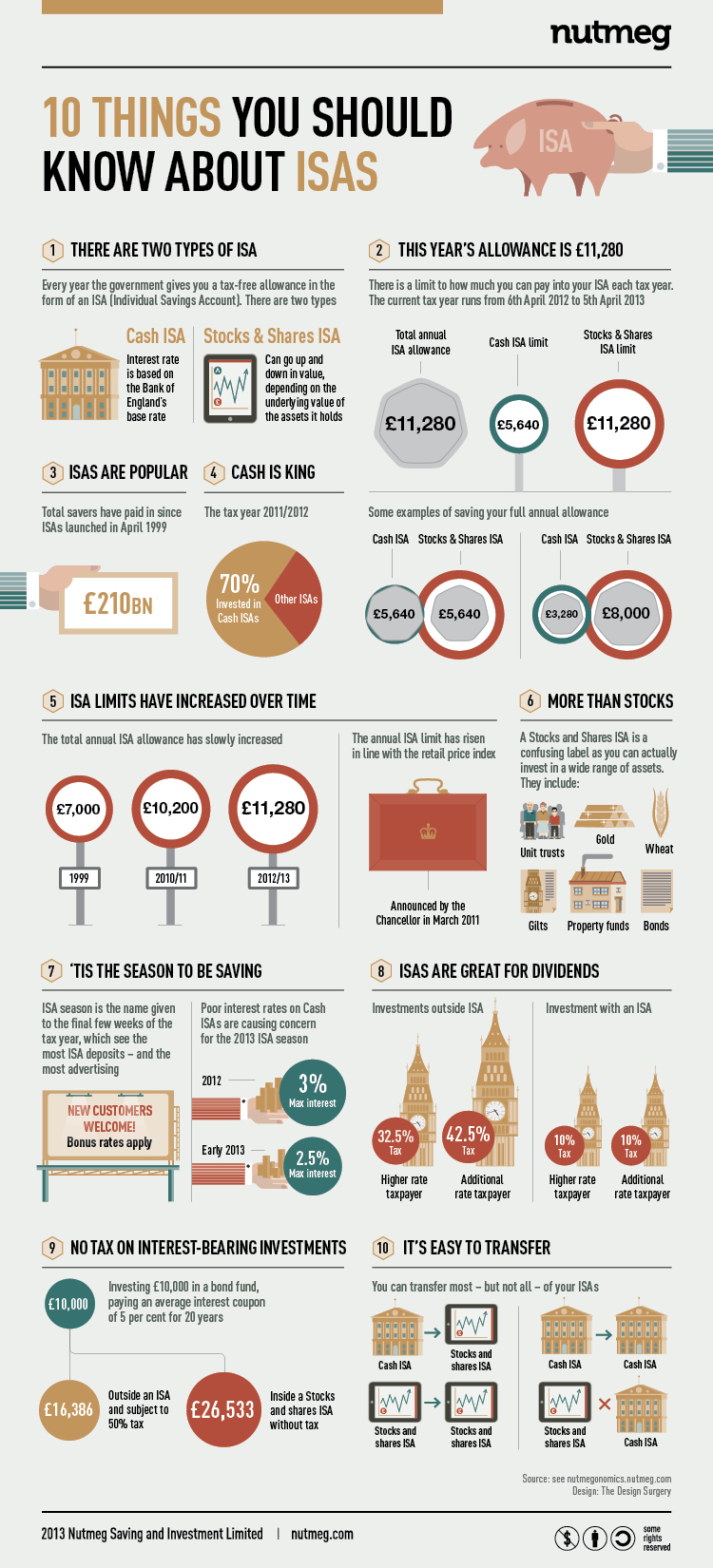
It’s ISA season, the time of year where you should be checking you’ve used as much of your tax-free allowance before the new financial year in April.


Source:  http://www.nutmeg.com/

The Nutshell of ISAs from Nutmeg:

  1. There are two types of ISA
  2. This year’s allowance is £11,280
  3. Isas are popular -don’t be left out!
  4. Cash is King – but saving for the long term should be in stocks and shares for their growth potential.
  5. ISA Limits have increased over time
  6. Stocks and Shares ISAs can hold a wide range of assets, not just stocks and shares!
  7. Tis the season to be saving
  8. ISAs are great for dividends
  9. No tax on interest-bearing investments
  10. It’s easy to transfer


{ 0 comments }

Getting the Most out of Your Accountant

by Magical Penny on February 27, 2013


 When you are in business you need to trust people to help you, be part of the team, whether that is as an employee, a partner, or as an external resource. External resources may include anything you pay for like your banking, your business accountant, even your cleaner.

 

All these suppliers are there to help you make your business run more smoothly, it’s only right that they are fairly remunerated for their services, but it’s also up to you to ensure no one is slacking. It is a strange fact that most businesses would notice immediately if the cleaners weren’t doing their job, and give them a hard time for it. Yet if their professional advisers aren’t pulling their weight they are more likely to get away with it – at least for a time. And you don’t need me to tell you who is on the higher day rate!

To make a relationship work closest to its best potential both parties need to contribute, and in business that might mean simply spending time with the other partner, in this case the accountant, and sharing plans and desired outcomes.


Your business will be better equipped to succeed if you have a plan, even if you don’t get around to writing that down.

Writing a business plan need not be difficult, and you can always find someone to help you. Once it’s written down it doesn’t mean you can’t change it as circumstances demand, but it does mean that it is easier to share with members of your team who you might not see that often.


Arrange meetings with your accountant every few months, and certainly as you approach your year-end and the end of the tax year.

Their advice could save you a lot of money at that time – but be prepared to be honest about what you are trying to get out of the business. If you don’t need to take every penny of profit then you might be better off putting an amount into your pension before the end of the tax year.


When you are planning a big purchase it is worth a catch up with your accountant too.

That might be buying assets that are obviously for the business, or something like a car that you consider to be more for your own use, but that still can be applied as a business purchase.

If you don’t keep the accountant up to date then you can’t expect them to be able to make suggestions, but likewise they should be asking you questions as well to find out more about what you are trying to do.


You should regularly challenge all your outgoings with a view to ensuring that everything is paying its way and delivering excellent value for your costs.

Your accountant will gradually become a bigger cost as your business grows. Keep on top of the relationship and ensure you are at least getting great value, and ideally saving considerably more than it is costing you through benefitting from their good advice.

{ 0 comments }

What to do if you need flexibility with your savings?

by Magical Penny on February 22, 2013


flexibility in savingsWhen it comes to saving money it makes a lot of sense to seperate your money into different buckets.



One of the first tips I ever give when someone asks me to help them save money is make sure they have opened a seperate savings account, away from their other accounts. The separation is important because it helps psychologically detach yourself from money that is to be spent soon and money that is to spent far in the future.

Both a savings account and a term deposit account are easy to set up and manage or monitor online, and both are great, fee free, ways to earn interest on your savings and investments.

However, which is best for you – an easy access  savings account, or a term deposit account? To help you decide here are a few pros and cons of each financial product, so you can learn more about the features and benefits of both options and choose one which best suits your particular needs, and your individual savings goals.


Easy Access Savings Account

An easy access savings accounts from Birmingham Midshires or elsewhere could be a brilliant way to separate your savings away from your everyday transaction account and earn you a certain rate of interest above the base rate. Easy access savings account providers can also often offer promotional or introductory rates to give your savings a boost from the start.

Pros of a savings account:

  • A easy access savings account is an easy to use, flexible and at call account. When you choose the best savings account for your needs, you will have an account which lets you make unlimited deposits and withdrawals without penalty, and one which allows you to boost your savings with an extra deposit, or withdraw funds in an emergency. The funds in your savings account are not only earning a high rate of interest, but they also remain at call which means you can access them through online banking if you reach your savings goal sooner than expected or change your focus, or if you need to cover an unexpected expense.
  • Your savings account will help you set up and stick to a regular savings plan. When you open a high interest savings account you can enter your savings target and the deadline for you to meet that goal. Your savings account will then track your progress and give you regular updates – sometimes even by SMS or email if you choose – to show you just how far you’ve come, and how close you are to reaching your goal. You can also set up automatic online transfers from your transaction account to your savings account to keep your savings regularly growing.

Cons of a savings account:

  • Instant or almost instant access to your savings can increase temptation to spend. As your savings account funds are at call, you can instantly transfer them to your transaction account and they will arrive immediately if the account is with the same provider, and in a matter of days if you’re not. Therefore, if you think that this would be too much temptation to spend your savings on frivolous items, or before you reached your goal, then perhaps a high interest savings account is not for you.
  • Your interest rate can be flexible. The interest rate offered on savings accounts is high at the moment and going up because the official base rate is also on the rise. However, the interest earned on your easy access savings account is the bank’s standard variable rate and is subject to change at any time. Therefore, if you have a long term savings goal or are looking for the security of a high interest long term investment, you may prefer the guaranteed returns of a term deposit.

Term Deposit Accounts

A term deposit account is not the inflexible, high stakes investment which many people see it to be. A term deposit account can be opened for a term of between one month and five years in most cases and you often don’t need a minimum deposit either.

Pros of a term deposit:

  • You have the choice of flexible terms and a range of payment and reinvestment options. Most term deposit accounts will not require a minimum investment to open the account and you can choose a term which best suits you – anywhere from one month to five years. You can also choose how your interest returns are paid for investments over 12 months and can have monthly, quarterly, six monthly or yearly returns paid to you as income. You’ll also have a range of reinvestment options offered to you before your term expires so you can ensure your savings continue to grow.
  • The interest rate you will earn is guaranteed for the entire term of the investment. From the moment you choose your initial investment, the term of the deposit and the frequency of interest payments you will know the interest rate your investment will earn. That interest rate is then guaranteed for the life of your investment and will not change, not matter what else happens in the market.

Cons of a term deposit:

  • To access your funds early penalties apply. A term deposit account may not be the right option for you if you don’t have an emergency fund, or you think you may need to access your investment early. A term deposit is able to offer you such high guaranteed rates because your funds are locked away for a determined period. Therefore, if you need to access your funds early you will be charged early exit fees, or you will earn a reduced rate of interest on your investment.
  • The best returns are on long term, high value investments. If you have a significant investment to make in a term deposit account and can afford to leave it for the longest term then you can make substantial returns. However, for smaller, short term investments a term deposit is not always the best option and you need to shop around for the best interest rate for your term and investment amount. For example, if you are looking at a term deposit for six months and the interest rate is advertised at 6.00% you will really only be earning 3.00% interest because the advertised rate is a per annum rate and you are only investing for half the year.

Follow Magical Penny on Twitter

{ 1 comment }

Going Green on the Roads of Australia

by Magical Penny on February 18, 2013


Transportation is a leading source of pollutants, which cause climate change. The major car manufacturers of Ford, General Motors, Toyota, Honda, Nissan, Volkswagen, Volvo and even BMW and Mercedes have all begun to produce greener cars.


Saving Money with a Hybrid

Hybrids combine a petrol-powered engine with an electric motor. They also generate energy from the heat arising from brakes. If you peruse the latest car news with motoring.com.au., you’ll find that the Toyota Prius is the most popular hybrid. Hybrids are more expensive that conventional cars, since the drive train which connects engine to wheels is more elaborate while the battery is sizable and of premium quality. Drive trains can be expected to fall in cost as technology improves, however this is likely to take in excess of two decades. The price differential between hybrids and regular cars is known as the hybrid premium.


Is it worth the cost?

A hybrid will cost more initially, but research by the US automotive research company, Vincentric, found that 11 of the 25 models examined evoked less costs than petrol-powered vehicles in the long run due to depreciation, insurance, finance, fuel consumption, taxes, fees, repairs and maintenance: the technology pays for itself.

People have expressed concern about the durability of the batteries of hybrids, but defenders of the faith say that some have driven more than 300,000km without a problem.

Using less petrol, hybrids are most well-suited to people who drive long distances. They emit up to 90 percent less carbon monoxide, hydrocarbons and nitrogen oxide. The quantity of petrol used varies by model, making it worthwhile to review the ratings of the Australian government’s Green Vehicle Guide before buying a vehicle. With the cost of petrol rising, using less is good not only for the environment, but a person’s pocket. Hybrids produce further financial benefits in that parking them is sometimes free.


Buying a Hybrid

The only electric car reviews you’ll ever see for cars available in Australia will be for the Holden Volt. One drawback of electric cars is their range. The petrol gauge of a car will issue a warning when there is a range of less than 100km remaining, but this is almost as much as the full range of some electric cars. Most journeys, however, are short, and rather than the endless outback highways and rugged mountain tracks seen in advertisements, almost all Australians drive in cities. In Sydney, fewer than 10 percent of cars move more than 100km in a day. The median distance travelled is under 35km.

Research conducted on behalf of insurance companies has proved that the drivers of hybrids are less at risk of accidents. Although some insurers give lower premiums for hybrids, perversely, some charge more. It would be best to avoid an insurer that charged more.


Ultimately, it is hoped the purchase of a green car will leave a better world for the next generation. Lower petrol use is also attractive because, per the Australian Competition & Consumer Commission, the country is likely to become increasingly reliant on fuel imports. Buying a green car would also be of benefit to the driver, financially.

Is this the way of the future?


{ 0 comments }

Rough Economy Affecting Employee Rights

by Magical Penny on February 18, 2013


The world economy is still struggling.

With unemployment figures at a record high, many people who are in work are accepting low standards of care at work in order to keep their position. Work-related stress, which can lead to clinical anxiety and depression, is on the rise as employees are ignoring the 48-hour per week guidelines set out in order to keep up with the pressure of an increased work load.

An extra contributing factor to this is the growing necessity for employees to take on more work than they are contractually obliged to do, and so are doing tasks outside of their professional field.


Employers, particularly those within medium and large businesses, are taking advantage of this fear of unemployment not only by piling on the workload, but by cutting back on benefits such as sick pay, holiday pay, and bonuses. The sick pay and holiday pay cut backs only add to the work related stress as employees feel they cannot take a break, and the cuts in bonuses mean they feel undervalued; all of this can contribute to rising levels of depression.

Know Your Rights

This is a very unfair situation.  The economy should not be affecting the rights of employees who are feeling increasingly over-worked and under-appreciated. It’s important that you know what you are entitled to by law, and not to let the fear of unemployment stop you from exercising your rights. This is not to say that you shouldn’t do your bit in the office through taking on extra work, but if it is resulting in illness or accidents then make sure you know your rights.

If you’re let go and you think it’s unfair, then work with solicitors who are experts in settlement agreements to ensure you get what’s rightfully yours.

The top thing to remember are that your employer is legally obliged to take every measure to ensure you are safe whilst at work. Should you have an accident or become ill and it was not your fault, there are laws in place to protect you. You are also protected against unfair dismissal if your employer takes action against you for filing a claim.

For more information about accident at work advice, you can click here.

{ 0 comments }

Using credit cardsMany people never take the time to consider how much they spend on their credit cards in our lifetime – and it’s no surprise: The point of plastic is that it’s easy; it’s always there and you don’t have to think about it.


However, if you do not pay off your credit card in full every month, then it is always gathering interest, even when you’re not thinking about it; which means that if you’ve left your bills alone for long enough you might be surprised to learn how much money you have been simply throwing away over the years.

Research conducted by the Telegraph newspaper suggests that many people in the UK could be paying out as much as £40,000 to their credit providers in interest alone – and that’s just on the plastic. The newspaper also suggests that the people who allow this level of debt to accumulate on their credit cards also have a greater propensity to take out other types of loans, such as personal and payday loans, and move into other lines of credit.

According to the Debt Advice Foundation – one of Britain’s leading debt help charities – people on average have reached £23,000 of debt before they seek help, which is certainly a frightening statistic.
According to Will Becker, Managing Director of leading credit card comparison site TotallyMoney.com, it’s even more surprising considering the number of deals available on credit cards for the likes of 0% interest balance transfers.

He said: “Far too many of us sit with a balance on the wrong credit card.  We’ve got used to switching car insurance every year and saving a packet, now we need to think about our credit cards the same way. The banks are falling over each other to get us to switch to record-breaking 0% deals: we should take them up on their offer.  The average person saves over £500 when they do.  The danger of doing something about our card debts now is that action is put off for years or decades and the drip, drip of monthly interest eventually adds up to a small or even large fortune.”


This could certainly dispel the myth that nobody is willing to lend money, but it also enforces the fact that people should shop around and seek out the best deals for themselves to avoid amassing too much interest.


Have Credit card debt?

Use this calculator to work out how much it is costing you!

[fmecalc cid=”25″ w=”500″ c=”0″ s=”3″ gs=”1″ incd=”0″ lid=”V1-25-5-10-17″]

Some even say you should cut up your credit cards altogether and just use your debit card to save yourself…but I’ll leave that judgement up to you!


{ 0 comments }

3 Reasons to Open a Self Invested Personal Pension

by Magical Penny on February 14, 2013

Pensions need a positive PR campaign. They are often misunderstood and subsequently ignored by many. You definitely should be saving for the long term whatever your age but navigating the dizzying array of options out there can be difficult. In this article I’m going to explain why pensions are good but if you’re in your 20s, other ‘saving vehicles’ may be better.

Firstly, a pension is just one way to invest for your future. Other options are investing in ISAs, or trying your hand at trading. For example, anyoption is a leader in the field of binary option trading. anyoption offers several online trading tools you can invest in.

But when it comes to investing for your long term future, a pension can be a great way to do it:

Pensions in Brief

A pension is simply another word for a ‘retirement’ account.

Pensions allow you to save for retirement quicker than any other way because your contributions are boosted by tax-relief. Here’s how it works. Say you earn £100. As with all earnings you need to pay tax on them so after tax you would be left with around £80 assuming you are a basic rate tax payer (most of us in our 20s are!). Put that £80 into a pension though and quicker than you can say “Magical Penny” that £80 will become £100 again -you’ve got your tax back.

In this regard pensions are great -because you can build up a lot of money in a short period of time. But there are catches. The biggest one is that you can’t access your pension until you are 55 or older. And you can only receive 25% of your pension value in tax-free cash when you convert your pension fund into an annuity by the time you’re 75 -something that turns lump sums into guarateed taxable income for life.

Note: if you are in America and have a  retirement 401k you can access your retirement money early, but it comes at a huge cost: you lose all tax relief AND have to to pay a 10% penelty if you access the money.

Despite the restrictions, pensions are great because they allow you to, at least in part, avoid paying any tax. Which means more money in your pocket. But it’s not as simple as that:

Pensions can be difficult to understand

Firstly its important to understand that a pension is not an investment in itself. Like ISAs, pensions are just like money envelopes that legally hide your money away from tax. But it’s up to you to decide what goes into your pension ‘envelope’. Many pension companies try to simplify the options when they present their ‘investment funds’ and assess your ‘risk profile’  but this very process often makes it difficult to determine what the money in a pension is being invested in. Certainly if you ask the average person what their pension is invested in, they would not know.

Even I didn’t know what my former employer pensions are made up of, despite trying to find more information about it!


Enter the SIPP

A SIPP, or ‘Self Invested Personal Pension’ is, in my view, the best kind of pension because as the name suggests, you have full control over what you put in your pension. You can use online platforms to find the cheapest funds, and it doesn’t take much effort at all to put together a bespoke set of investments that are low cost and suit your needs, rather than investing in a generic fund that can be bloated with fees and associated costs.


3 Reasons to Open A SIPP

Tax Efficient Saving

Like all pensions the biggest benefit is protection from tax  -the money you would normally have paid in tax out of your earnings is directed straight into your pension. And the more money that gets into your pension, the more it will hopefully grow over time.

More Choice

Many workplace-based pensions are limited to certain ‘fund families’ or investment companies meaning your investment options are limited. But with a SIPP you can invest in almost anything, and find the lowest cost investments. One thing to caution though is not to chase returns. Most of the time the highest performing investments one year become the worst performing investments the next year. By using the benefit of choice, you can better control your investment costs -the only certainty when it comes to investing. Generally, the lower the investment cost the higher the ‘risk-adjusted’ return…i.e. higher performance for the amount of risk you are taking on.

More Control

Most pensions don’t give you much control. For example my employer pension doesn’t have online access, and if I want to change the investments in my pension I have to contact a financial advisor. Meanwhile with a SIPP I could choose an investment provider that gives me online access and be able to monitor and change my investments as I see fit. Whilst investments are best left alone (because more trading increases costs which eat into returns) it still is good to monitor your investments to make sure your portfolio is not lagging the market by a significant margin. With a SIPP you are not a hostage of circumstance and have much more control.


Despite the advantages of a SIPP, they are not for everyone – if you have not used your Stocks and Shares ISA allowance then start there, as SIPPs can be slightly more of a hassle to manage.


Read more about pensions here: http://magicalpenny.com/tag/pensions/


{ 3 comments }

Sponsored Video: Saving money with a better fridge

by Magical Penny on February 14, 2013

Few of us could function without a fridge, but running a fridge over it’s lifetime can be expensive, and could be costing you more than you think.


After central heating, domestic cooling appliances like fridges and freezers are the biggest contributor to your energy bill because they’re left switched on all the time. They account for 20% of electricity used by all of the domestic appliances in the average UK home. It therefore makes sense to invest in energy- efficient appliances when you come to upgrade your goods.

Energy running costs affect the true price of a fridge – one that’s cheap to buy but pricey to power could work out more expensive in the long run.

One way to get an idea of running costs is to examine the EU Energy label when you purchase a fridge. All fridges have EU energy labels ranging from the ultra-efficient A+++  to  G ratings.  Since July 2012 all new fridges, freezers and fridge-freezers must have a minimum rating of A+, so if you have an older fridge it may be time to upgrade and quickly make up the cost in energy saving!

Even models which have the same energy-efficiency rating can have very different annual running costs. Consumer advocate Which? has tested many different fridges and found that two A++ rated washing machines can vary in energy cost by 30%, or £130, over five years.


This post was sponsored by Samsung 

{ 0 comments }

Video Calling for Business

by Magical Penny on February 12, 2013

video callCommunication might not be the top priority of most businesses, but without it, how would your company be able to sell its services and products?

To try and get ahead of your competitors, it’s important to make sure that all the tools you have at your disposal to communicate with clients, investors, potential employees and remote workers are the best around, one of those being conference calling from companies like Powwownow.co.uk.

Online video conferencing is a must-have for any company who wants to communicate with ease, but how can it help?

Video conferencing can save your business time

Going to a meeting far afield can be time-consuming at the best of times, as travel can take a few hours out of the working day. Arranging a conference call can be just as effective in terms of face-to-face communication, while it takes only a few minutes to set one up and invite people. The time saved could be used for something important like paperwork or perhaps for another meeting with a client, which enables you to do more and potentially make more money.


Saving money is also possible if your business starts to use video conferencing. Having a conference call in place of a more traditional meeting would wipe out potentially expensive travel costs, and doing this on a regular basis could add up to something more significant in terms of savings. In some cases, conference calls are also cheaper than making phone calls, especially to any clients or investors who are based abroad, while it’s also bound to save some of your employees a bit of money too by making it easier for them to work from home.
Effective communication is perhaps the best attribute that conference calling, whether by video or audio brings to any business. You could speak to just about anyone in the world if they have the capability to join in a conference call, invite several people into a call from separate locations and get your point across clearly and thoroughly. If your business decides to use conference calling, it could be the most essential communication tool you have.

{ 0 comments }