The Price of Happiness: When More Money Stops Meaning More Life
I came across this graphic recently showing the supposed “price of happiness” across major UK cities.
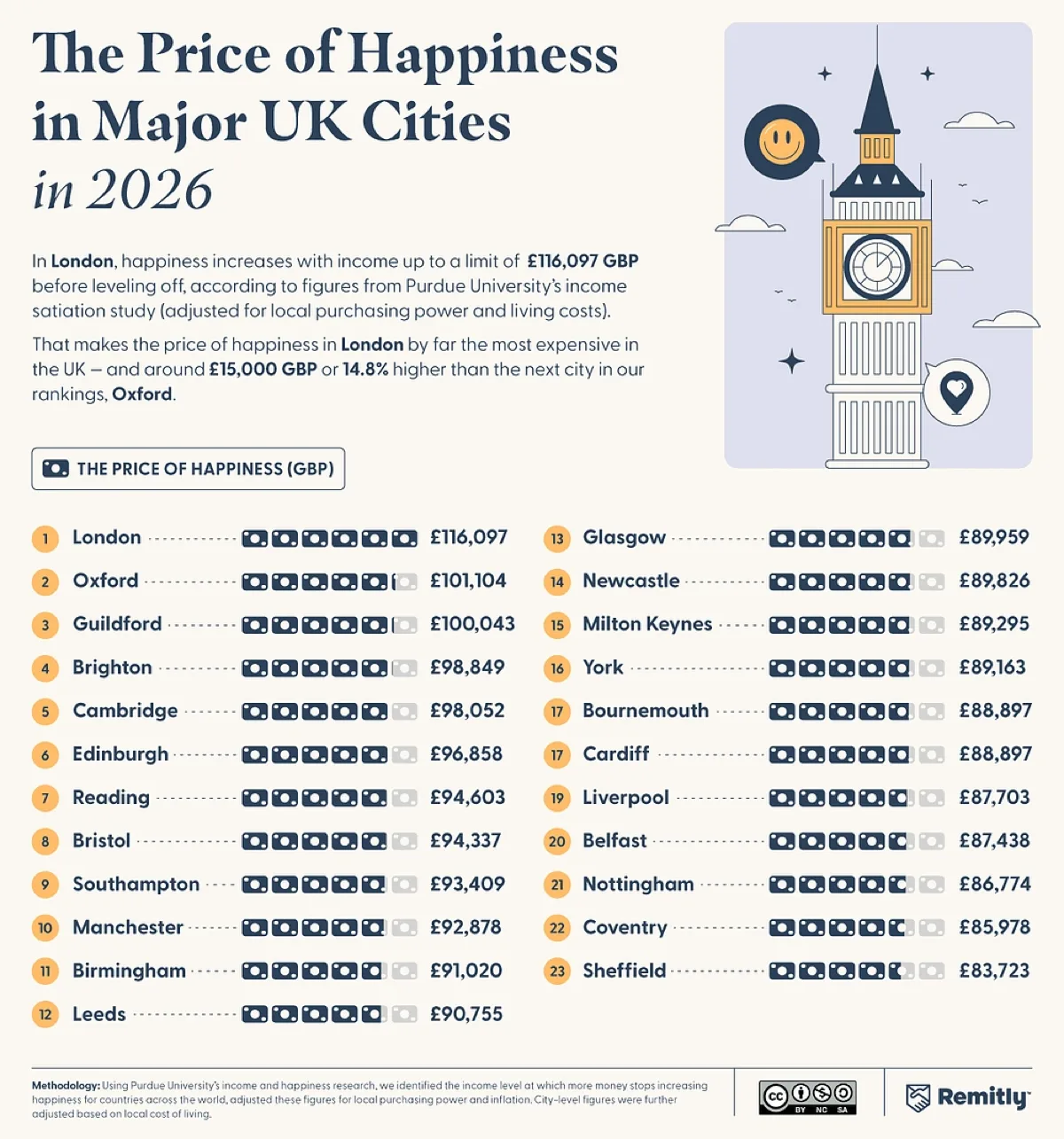
The figures are striking. According to the research behind it, income continues to increase happiness up to a certain point, but eventually the effect begins to level off. Adjusted for local living costs, that point ranges from around £84,000 in Sheffield to an extraordinary £116,000 in London.
Leeds comes in at about £91,000, York at £89,000, Manchester at £93,000 and Edinburgh at £97,000.
There are plenty of caveats to numbers like these. Happiness is not a product you can purchase for £89,163, and an individual person’s circumstances can make the amount of income they need enormously different.
But I think the underlying idea is much more interesting than the precise numbers.
We spend a lot of life assuming that more must be better
There are obvious reasons why earning more money improves our lives.
Going from struggling to pay the electricity bill to having some breathing room is hugely significant. Being able to deal with a broken boiler without panic matters. Having savings, being able to take a holiday, pursue hobbies, help your children or occasionally say yes without checking the bank balance first all have genuine value.
Financial security buys something incredibly important: choice.
But the value of each additional pound isn’t necessarily the same.
The difference between earning £25,000 and £40,000 might fundamentally change someone’s life. The difference between £85,000 and £100,000 might be pleasant, but it is unlikely to have the same transformational effect.
Eventually, another £10,000 can simply mean a slightly nicer version of a life you already had.
And sometimes earning it comes with a price of its own.
What are you exchanging for the next £10,000?
This is the question I find more interesting.
Perhaps the next promotion means longer hours.
Perhaps the higher-paying job means a worse commute, more pressure or giving up flexibility.
Perhaps increasing your income means sacrificing evenings with your family, hobbies you love or the ability to disappear for a long weekend.
None of those things automatically make the extra money a bad decision. Far from it. Ambition is valuable, and earning more can unlock opportunities that weren’t previously available.
But there is a point at which maximising income and maximising life cease to be quite the same objective.
The danger is that we don’t notice when we’ve crossed it.
Our lifestyles expand. Our expectations move. The salary that once seemed enormous becomes normal remarkably quickly. Then somebody else earns more, owns a bigger house or has a more impressive job title, and the finishing line moves again.
There is always another rung on the ladder.
There isn’t necessarily another Tuesday evening.
Financial planning shouldn’t just be about making the number bigger
Working in financial planning, I think this is one of the most interesting tensions in the profession.
We’re surrounded by numbers: investment returns, pension values, tax allowances, withdrawal rates, salary, net worth.
Naturally, we often assume that the objective is to maximise them.
But a good financial plan shouldn’t necessarily produce the largest possible pile of money.
It should help produce the life that money is there to support.
That might mean pursuing the promotion.
It might mean retiring earlier rather than wealthier.
It might mean reducing your hours.
It might mean spending £5,000 on an unforgettable family holiday rather than adding £5,000 to an already healthy investment portfolio.
It might even mean deciding that you already earn enough.
And “enough” is a surprisingly powerful concept.
The ceiling isn’t an argument against ambition
I don’t read research like this as saying we should stop striving.
There is enormous satisfaction in improving at something, progressing professionally, building something, achieving difficult goals and creating greater financial security.
Striving itself can be part of a happy life.
The important distinction is between progress with a purpose and progress because we’ve forgotten how to stop.
Perhaps the useful question isn’t:
“How much more could I earn?”
It’s:
“What would earning more allow me to do that I can’t do now?”
If you have a compelling answer, brilliant. Keep going.
If you don’t, perhaps the scarce resource you’re trying to accumulate is no longer money.
It might be time, freedom, relationships, experiences, health, creativity or simply space in the diary.
Money is exceptionally good at helping us build a life.
But eventually, we have to remember to actually live it.
You must log in to post a comment.