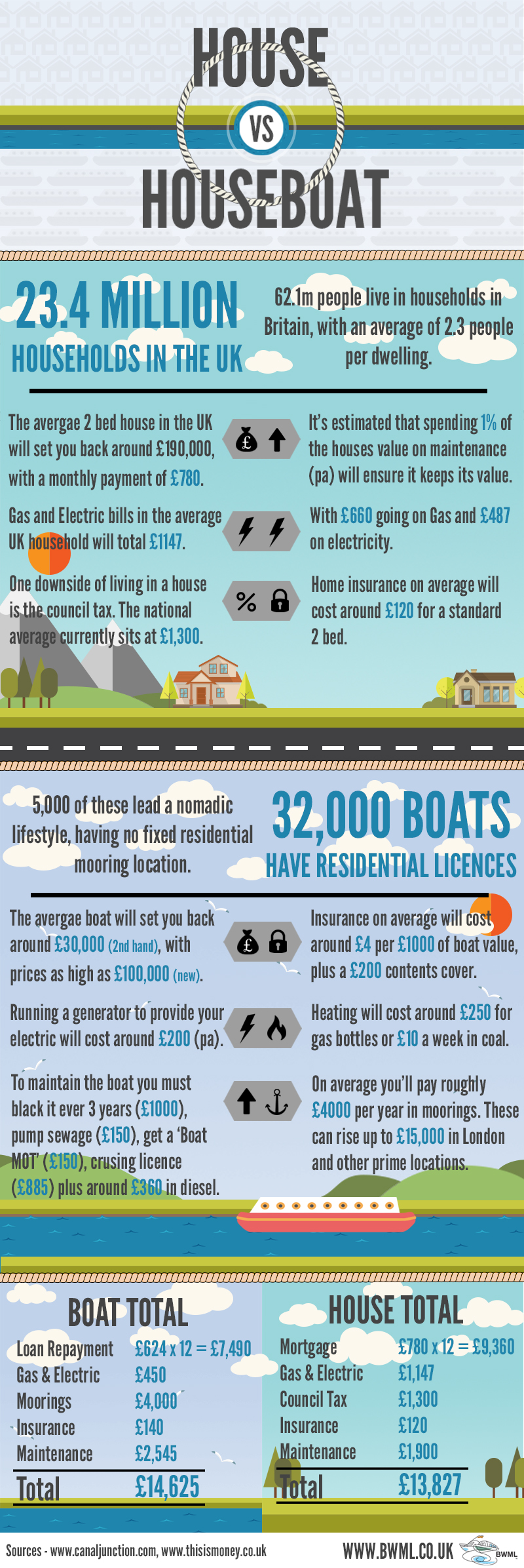
Buying a house is often the most expensive purchase you will make in your life. And even if you rent, living in a house has fixed costs to consider.

The average 2 bed house in the UK will set you back around £190,000, with a monthly payment of £780. And that’s not all. It is estimated that spending 1% of the house’s value on maintenance per year will ensure it keeps its value. Add to that the costs of utilities and insurance and your budget is squeezed further. Whether you rent or own your house, one considerable cost of living in a house is council tax. The national average council tax bill currently sits at £1300 per year.

All those costs, and you’re stuck in the same place!

Have you ever considered a more alternative lifestyle of living on a houseboat at a boat moorings instead? Certainly a house boat will not increase in value like a house tends to do, but the costs involved provide some food for thought!

The real magic is working out what really matters to you in life, and what is worth spending your magical pennies on. Is a house-boat life for you?

Thanks to BWML for providing this infographic:

Boat vs House

{ 0 comments }

BuyingThose paying attention to the world of financial technology can’t fail to have noticed the unprecedented growth experienced by the industry in just a few short years.

In 2015 alone, the number of FinTech startups in the United States valued at over one billion dollars grew to almost fifty and counting, with many more companies in the peer-to-peer lending and alternative finance markets predicted to see their value sore throughout 2016.

With Silicon Valley somewhat predictably leading the charge in FinTech innovation, and with reports estimating that American investment in financial technology is set to increase to at least $4.7 billion over the next two years, this is hardly surprising.

Yet whilst American enterprises may be the talk of the town in an industry which has garnered some serious attention in both the finance and tech worlds over the last few years, they’re not the only ones with cause to celebrate.

Earlier this March, a report by Innovative Finance revealed that UK investment in FinTech companies rose by 35% in 2015, with at least $901 million ploughed into the sector across 72 separate venture capital deals.

The figure puts the United Kingdom second in the league table for the biggest number of deals done, with the US once again ahead of the pack. In terms of the total amount of dollars invested, the UK now ranks in third place, after both America and China.

laptop smallHow did it happen?

According to the data provided by Innovative Finance, a large percentage of $901 million was invested in financial software solutions created by those in both the aforementioned peer-to-peer lending and alternative finance sectors, as well payment and remittance segments, the three together accounting for 60% of VC investment in UK FinTech. Writing in Tech City News, reporter Yessi Bello Perez records that the volume of investment rocketed to 74% when challenger banks were included in the figures.


Who’s responsible?

Contributing the majority of the VC funding to the UK market are names like British peer-to-peers lenders Funding Circle, TransferWise, WorldRemit, and RateSetter, as well as social trading firm eToro (headquartered in Cyprus but with a base in London). Money transfer services Azimo and The Currency Cloud, Italian-owned MoneyFarm and crowdfunding investment specialists Seedrs also made a significant impact on UK companies leading the way in creating unique banking software and other online financial services.


Going forward

The 35% increase in 2015 seems well in keeping with current industry trends which, if they continue the way they are, could well see investment figures swell even further throughout 2016 and 2017.

Over the past few years, the likes of financial software provider Misys and other industry veterans have continued to earn acclaim for their new approaches to solutions for banks and financial institutions, perhaps proving that the industry as whole is ready to embrace innovation.

With Misys et al working side by side with new startup firms, the sector as a whole could well serve to grow even further in value over the next few years, especially if (and when) the money put into the sector begins to yield dividends for the likes of Funding Circle and WorldRemit.

In a February 2016 article on Growing Business startup blog, WorldRemit founder Ismail Ahmed told writer Henry Williams that he has “no doubt” that the company’s $1 billion investment was a good idea, leading some to speculate the company -and others like them- could funds into a UK FinTech industry which Mr. Ahmed describes as having “an absence of the frivolity that sometimes characterises a burgeoning tech scene.”

By doing so, these investors could well help financial software startups in the UK to further gain even further ground on a US industry which still takes most of the credit for the recent explosion of interest in FinTech investment.

Exciting times are ahead.


{ 0 comments }

What you need to know before applying for a loan

by Magical Penny on March 23, 2016

ImportantNo matter how good you are at saving, sometimes life throws you a curve-ball and you may need to consider applying for a loan to help you out. But first, run through this list of considerations to be better informed about what you need before you sign on the dotted line.


Work out how much you need

It might seem like a simple question but working out how much you need is a really important first step. It’s important you do not borrow too much, as debt costs money and unnecessary debt is expensive. When you borrow money you are paying for the privilege of being able to use someone else’s money to fix your problems today. It may be tempting to borrow as much as you are offered by a lender but if you do, you could find yourself with debt that you may struggle to repay. Instead, have a figure in mind before you look for what is available and stick to it.

Similarly, there is a risk that you borrow too little! You may have been unrealistic with how much money you need and later find you need to take on more debt, perhaps on a more expensive loan, when you could have simply borrowed a realistic amount at the start of the process and saved yourself hassle and money.


What type of loan is most appropriate?

 A secured loan is one held against your property. The most common types of secured loan are house loans (known as mortgages) and car loans. They are normally for more than £10,000 and if you fail to repay, the company who owns the loan can take away your property. As the debt is secured on property, it is less ‘risky’ for the lender so the interest rate is often lower than an unsecured loan.

An unsecured loan is a loan that is not secured against any property, but that does not mean you don’t have to pay it back! Unsecured loans are often smaller than £10,000, and typically have a higher interest rate than a secured loan.

A third type of loan is a guarantor loan. Whilst technically it is a type of unsecured loan, there is an element of security on the loan – the guarantor. A guarantor is someone who is also responsible for the loan if you can’t pay it. A guarantor loan is good for people who need a loan but can’t get one on their own: either they have a bad credit score, or they don’t fit other lending criteria. If you need a loan, can’t get one the traditional way, but have a friend or family member who is happy to act as guarantor, a guarantor loan could be the solution for you. One company that provides a guarantor loan is Trusttwo. If you do go this route, be sure to make sure the guarantor fully understands they are responsible for the loan if you can’t pay it for any reason. Don’t let debt ruin a relationship.

If you only need to borrow over a very short term – say 12 months or less – then you may be better off with a0% interest credit card, if you qualify for one. By making a purchase or balance transfer onto a 0% card you will have the length of the introductory offer in which to pay back the money you owe without paying any interest. Don’t be tempted to keep spending until you have cleared the balance however, because at the end of the 0% period you will be charged interest at a much higher typical rate.

Caution: If you make a transfer of the balance of an old credit card to a new card at a bonus rate or low rate, do NOT make purchases on the card. If you do, they are likely to have their own interest rate and any repayments you make to the card might not go to pay off the purchases but rather they might go on paying off the transferred balance. This could mean you may end up paying high interest on your purchases after all until you have paid off the balance-transfer amount.

Don’t Take the Advertised Rate at Face Value

Lenders often advertise an attractive ‘typical’ interest rate for the loan. However this is not a guaranteed rate and depending on your circumstances the loan could be more expensive than you might have initially thought. This is because most loans have what’s called ‘risk based pricing’. If you are a more risky individual in the eyes of the lender, you will pay more with a higher interest rate.

 Improve your credit score

If you don’t need a loan straight away it could be worth trying to increase your credit score before applying for a loan. You can do this by reducing the amount of debt you have compared with how much debt you have access to, and ensuring your existing debt repayments are always on time. If you do these two things, over time your credit score will go up and the rates available to you next time you need a loan will be lower and therefore cheaper.


{ 0 comments }

When Do You Consider Yourself To Be In Debt?

by Magical Penny on March 21, 2016

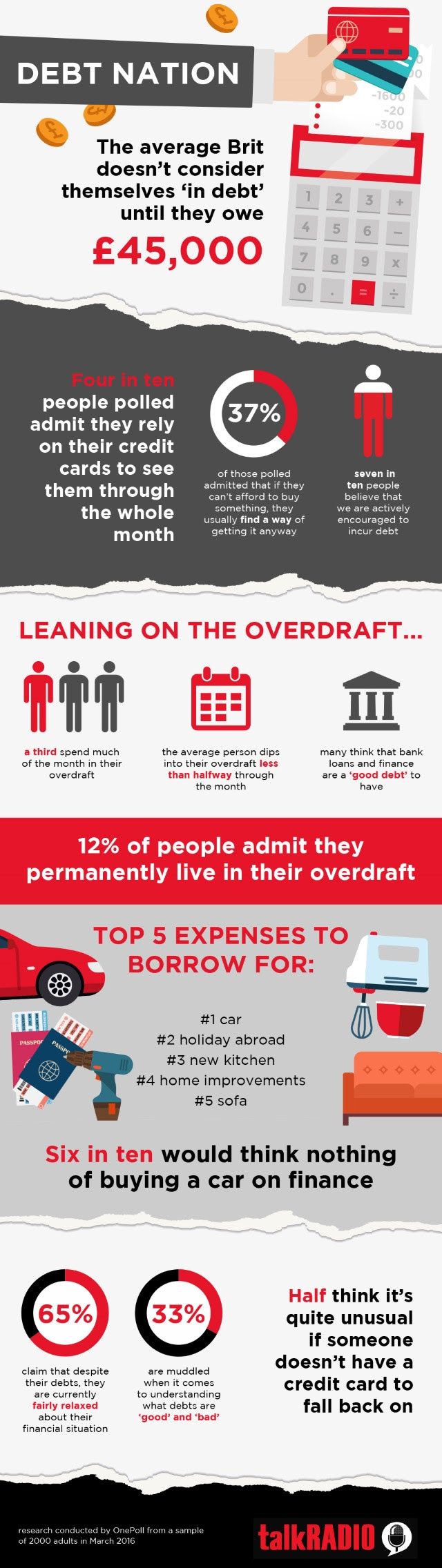
The average Brit doesn’t consider themselves ‘in debt’ until they owe £45,000, according to concerning new research.

This recent study into the financial behaviour of 2,000 adults, from this month (March 2016) by new speech radio station talkRADIO, shows the majority have a worrying lackadaisical approach to borrowing and owing money.

Four in 10 people polled admit they rely on their credit cards to see them through the whole month, and usually have a balance of at least £3,000 debt to pay, while a further third spend much of the month in their overdraft.

But it is only when the mountain of debt reaches above £45,000 that people start to panic, and realise that they need to take action to remedy their financial situation.

The research highlights that the days are long gone when an overdraft was for emergency borrowing only and a credit card was something we pulled out when there was no other option. Certainly increasing numbers are blogging about their journey out of debt, which can creep up through even perceived ‘normal’ spending.

Another research finding was the average person dips into their overdraft less than halfway through the month, with twelve per cent of respondents admitting they permanently live in their overdraft.

debt infographic march 2016

Source

Good and Bad Debt

When it comes to understanding what debts are ‘good’ and ‘bad’, a third of adults admit they are muddled. Council tax debt, tax debt and utilities companies chasing for payment are considered the very worst kind of debt to be in. But mortgages, student loans, finance options and bank loans are largely considered ‘good debts’ by many.

But debt, regardless of what type it is, can stop you from achieving your financial goals. Even ‘good’ debt, should be eliminated.

For more articles on Debt, read the Magical Penny Debt archive.

{ 0 comments }

three-fingersAccording to statistics, consumer spending increased to a record high during the fourth financial quarter of 2015, and this is usually a sign of strong economic growth.

Some experts have noted that this growth is being powered largely by higher levels of borrowing, however, which suggests that the economic rival in the UK may be based on short-term metrics. This may cause some concern, especially with several economic factors pointing to a global recession later in the year.

 This is where we must all take individual responsibility for our own financial future, as we look to reduce outgoings, save regularly and build a secure source of wealth.

With this in mind, here are three effective savings methods that can help us to achieve these goals: –

 1. Eliminate your Debt

 Debt is one of the main barriers to saving money, as we are continually forced to commit our capital to paying bills and reducing deficits. This can be debilitating, so eliminating debt is the first step towards building your savings and achieving some form of financial security. You must first calculate how much it takes to service your debt each month, before opening up lines of communication with creditors to create viable payment plans. This will enable you to gradually eradicate interest repayments and eat away at your debt, freeing up more of your income to invest into savings.


It is also worth reviewing an up-to-date credit report, as this may help you to identify credit agreements or debt liabilities that are inaccurately recorded. These can then be challenged and even removed where applicable.

 2. Set savings goals and identify the best accounts

Once you begin to save, you will need to set goals and identify the best vehicles for accruing interest. Establishing savings goals enables you to introduce discipline and create a viable fiscal plan, while choosing the right accounts ensures that you are able to access the best and most rewarding interest rates. From private investment to the new individual savings accounts and self-invested personal pension plans, you will need to compare the full range of the market if you are to make an informed choice to suit your goals and expectations.


 3. Speculate to Accumulate

 Over time, these methods will help you to build savings and accrue wealth. This opens up new savings opportunities too, so long as you are willing to speculate and spend money in order to reduce future costs. The procurement of solar panels is an excellent example, as while this represents something of an expense it typically repays your investment after five years and delivers a nominal profit thereafter. By investing in the reduction of your energy consumption and costs over time, you can reap rich rewards in the long-term.


{ 0 comments }

The Budget 2016 has now been and gone, but there are a number of big changes that will be coming in the next few months as a result. Stamp duty is being transformed for both residential and commercial property purchases. Let’s find out what that will mean for investors.

stamp duty change 2016How is Residential Stamp Duty Changing?

With interest rates at an all-time low, investing in residential property has been extremely popular over the last few years, but could the repercussions of the Summer Budget hamper this?

As of April 1st 2016, all purchases of buy-to-let or second homes in England or Wales will incur a stamp duty charge that is 3% higher than before. This will mean that the average buy-to-let property costing £184,000 will now have a £6,700 stamp duty charge, up more than £5,000 from the £1,189 that would have been charged previously.

Investors will now also have to pass checks usually taken by a typical mortgage applicant, proving that the rental income will be more than the monthly buy-to-let mortgage repayment amount and that they can afford to purchase the property.

The new stamp duty charges will apply to all property purchases, unless a landlord owns more than 15 properties. This will mean much higher purchasing costs for investors, which may result in some investing elsewhere.

However, if you are still considering investing in residential property, you should also know that mortgage interest reliefs are being cut and the wear and tear tax will be replaced by a new system in 2017. Plus, as of February 1st 2016, landlords can now run ‘Right to Rent’ checks on all possible tenants.

The Treasury has also confirmed that when it comes time for landlords to sell their buy-to-let properties, the initial purchase costs can be offset against capital gains tax (CGT), making the process much more affordable in the long run.

How is Commercial Property Stamp Duty Altering?

In the Budget 2016 held on the 16th March, there were big changes announced for commercial property investors too.

There will be a big tax cut for small firms and commercial property investors. The commercial stamp duty process will be reformed so that it works in a similar way to the recent residential brackets system. Commercial stamp duty will be charged on the value above the nearest tax band, so the following rates will be charged:

Under £150,000 – 0%

£150,001 to £250,000 – 2%

Above £250,000 – 5%

“These reforms raise £500m a year. And while 9 per cent will pay more; over 90 per cent will see their tax bills cut or stay the same.” Said George Osborne, Chancellor of the Exchequer.

“So, if you buy a pub in the Midlands worth, say, £270,000, you would today pay over £8,000 in stamp duty. From tomorrow you will pay just £3,000.

“It’s a big tax cut for small firms. All in a Budget that backs small business.”

What Will This Mean for Financial Investors?

With higher residential stamp duty rates and lower charges on commercial purchases there is likely to be some movement towards investment in business premises rather than traditional buy-to-lets.

However, for those who prefer to still purchase residential property, the increased charges are likely to be reflected in rental costs, with monthly fees charged from tenants most likely increasing considerably to recoup initial costs. How large the impact of the budget will be is yet to be seen, so watch this space.

Pure Commercial Finance is an independent financial brokers firm which specialises in commercial finance. So, if the Budget 2016 announcement has encouraged you to invest in commercial property, call Pure Commercial Finance on 02920 676727  to learn more today.
{ 0 comments }

Buying Your First Property Stress-Free

by Magical Penny on March 17, 2016

Buying your first property is said to be more difficult than ever; a lack of properties to choose from, high prices and stiff competition are all factors that can leave you with a real headache. There are, however, steps that you can take that will make the experience a happy and memorable one.

house mortgage UKDeposit Dilemmas  

It is paramount to have all of your financial concerns worked out before you do anything else. Start by addressing the issue of a deposit, if you’re lucky enough to have been able to save a significant deposit, then count your blessings, if not then consider your options. It may be the case that a family member or close friend can lend you the money for a deposit at a really low interest rate or interest free. This is a great option, but make sure both parties are very clear when it comes to the terms, write them down and stick to them to avoid future conflict. Securing a deposit by taking out a bank loan or by using a credit card, should be considered carefully as both are subject to charges and having to do this may indicate that you should wait a while and save some money or downsize your expectations.

 Mortgage Magic

Finding a suitable mortgage is the next logical step to take. The good news is that there are lots of great deals to be found for first time buyers, companies like Saffron Building Society specialise in helping first time buyers, they require as little as a 5% deposit and have competitive interest rates. Making sure you get a great mortgage deal and don’t overstretch yourself in terms of borrowing is crucial to buying your first home stress-free.

More Money

Bear in mind, when calculating your finances, that there are several other costs you’ll need to pay, solicitors fees and the like all need to be factored in to the equation.

 houseRealistic Research

Once you have your finances in order, the exciting part of the process can begin, you have to go out and find a home. This should be an enjoyable experience and so be realistic to ensure it doesn’t stress you out. Do your research, look in areas that you like and that are practical for you, but not in areas you are unlikely to be able to afford. Only consider properties that meet your basic requirements, such as size, access to transport links, parking, proximity to amenities and remember that your first home is just that, your first home, and it’s unlikely to be your “dream home”.  

 Home Sweet Home

Once you have found a property you like, it’s time to “make an offer”. Most prospective buyers will offer under the listed asking price and wait for a response and this will be accepted, rejected or a counter-offer will be made. Most people don’t get the first home they make an offer on, so don’t worry if you don’t. Remain calm and carry on regardless, but do make sure that you stay realistic about your expectations. The last thing you want is to end up in a situation where you lose out time and time again.


Taking a realistic, sensible and positive approach to buying your first home can see you completing the process in a matter of months and having suffered very little or indeed no stress. Good luck!

{ 0 comments }

Craziest Tax Deductions That Worked

by Magical Penny on March 16, 2016


If you are self-employed, or even if you are not but have made investment gains or have other income, you need to complete a tax return each year.

tax paid 201415I have needed to do a tax return for the last few years due to income derived from this very site and a few other online ventures. I also do quite a lot of paid singing work in addition to my day job as a paraplanner in a financial planning business. Completing my tax return each year has been relatively simple but keeping track of expenses for the purpose of documenting them on a tax return takes some time.


You can claim for many different things as a business expense, but not everything qualifies. In America, tax returns are more prevalent than here in the UK and this info-graphic details some rather wacky business expenses that actually worked and were accepted!

Have a read and I guarantee some of them will make you smile!

the-craziest-tax-deductions-that-worked-infographic

Credit: allfinancetax.com

{ 0 comments }

 10 Golden Rules For CFD Trading

by Magical Penny on March 4, 2016

BuyingEverybody believes that they understand the golden rules of CFD trading, but most beginner traders still make numerous mistakes and only few go on to become successful in their trading careers.

I have a friend who has been CFD trading recently on an app on his phone and he (and you) might find these rules helpful if you’re wanting to trade profitably.


The following are the 10 golden rules for CFD trading


1. Letting profits run and cutting losses

Most traders blow their CFD trading accounts by simply failing to adhere to this rule than probably any other reason. Clinging to losing trades for too long while cashing in on the profitable ones too fast results in a small number of catastrophic losses and a series of small wins.

 2. Using logic rather than emotion

Traders that base trading decisions on emotions might make the occasional big win but the reality is that they seldom will ever be profitable consistently. This is why it is important to have trading rules and sticking to them at all costs.

 3. Limiting exposure to just one trade

Traders that bet 50 percent or more of their CFD trading capital on a single trade are no longer traders but are now gamblers. You must never risk more than 2 percent of your available capital on a single trade no matter how ‘sure’ it seems.

4. Combining fundamental analysis with technical analysis

Traders that employ a combination of technical and fundamental analysis stand greater chance at becoming successful than those that employ just one of these methods. A good rule to apply is using fundamental analysis for ‘triggering’ the trade and technical analysis for the actual entry.

5. Timing is crucial

Even when you are right about the long-term direction of the market, an early entry can result in significant losses. Waiting for a ‘trigger’ along with at least one confirmation signal ensures that this never happens all too often.

6. Never add to losing positions

Good traders learn the distinction between trending and range-bound markets. Without this skill they would make the fatal mistake of adding to their losing positions due to the mistaken expectation that price will turn around. A good tool to use here is trend lines.

7. Understanding Risk vs Reward

Every trader needs to understand the trade-off between risk and reward. Never enter a trade whereby the potential risk is greater than the potential reward.

8. Trading with money you cannot afford to lose

Most people mistakenly believe that CFD trading or trading with other financial instruments online is a quick and easy way to earn money. Therefore, they use money intended for other important projects such as paying for their mortgage and eventually lose it all. Never trade with money you cannot afford to lose.

 9. Wise Use Of Stop Losses

Trading without a stop loss is the quickest way to a fast and total wipeout. Setting stop losses too tight can lead to the slow but eventual wipeout. Use stop losses that give the market enough room to ‘breathe.’

 10. Admitting personal weaknesses

The psychological makeup is perhaps the single most important difference between a winning trader and a losing one. A winning trader understands that he or she must never give in to weaknesses such as fear and greed. To address this problem, you need to plan you trade, trade your plan, and practice strict money management.

Conclusion

The 10 golden rules for CFD trading are vital if you ever wish to become a successful trader. Start implementing these rules and you will increase your odds of being successful.

{ 0 comments }

How Can Invoice Discounting Aid Your Business Processes?

by Magical Penny on February 26, 2016

Important or urgentInvoice discounting has a reputation of being for businesses that are facing cash flow problems. As well as being a perfect solution to slow-paying customers and shortage of capital, it is also a legitimate way to finance the growth of your business. Here we’ve explored the ways that invoice discounting could help your business if used in the right way.

What is Invoice Discounting?

Invoice discounting gives you immediate access to the cash you’re owed in your invoices. It means that you will no longer have to wait 30+ days for the customer to pay you, and your customers will never know about it. Businesses like Touch Financial will help find you such a service as well as providing information on a range of other types of invoice finance too, but how can such services aid your business?

Cash Injection

Up to 90% of your unpaid invoice can be turned into cash almost instantly, which you can use as an injection of capital into any area of your business. It gives you confidence that you’ll receive the cash at a certain time, which not only helps you out from a cash flow perspective, but it means that you can plan the way that you’ll use it too.

Speedy Payments to your Suppliers

Because you’ll have the money owed instantly, it means that you can pay anything you owe too. This means that your reputation for paying promptly will improve within your supplier network. You will have more people and companies wanting to work with you, and your business will grow exponentially.

It will also give you both the time and the power to negotiate better deals with your suppliers, and/or take advantage of new business opportunities, thus improving your profit margins.

Managing Your Sales Ledger

This form of finance means that you’ll never outgrow your available cash, which means that there is no need to worry about spending more than you have. It is a line of credit that will automatically increase as your sales increase, with no need to renegotiate like you would have to with a bank overdraft.

Unlike invoice factoring, with invoice discounting, you have complete control of the sales ledger, so your customers don’t have to know that you’re using it.

Overall, the main benefit of invoice discounting is that it allows instant access to your earned money instantly. This allows you to keep your cash flowing in and out of your business without any potential hold up to business procedures.

{ 0 comments }