Habits That Can Improve Your Financial Standing Fast

by Magical Penny on July 11, 2019

If you want your money to grow exponentially, and to make sure that you have a strong financial base for the future, then there are many things that you might want to focus on.

The truth is that, while it can be challenging to be able to do this, it is always possible, and just about anyone can take actions that will ensure that they are improving their financial standing as quickly as necessary.

Compounding growth

In this article, we are going to take a look at a number of the habits that you can take on if you are keen to ensure that you are improving your financial standing fast. As long as you consider these, you should find that you are in a much better position to be able to keep your finances where you need them to be, and that you can improve things much more quickly than you might have thought possible.

Saving More

One of the most important things you can possibly do with your money is to make a point of saving as much of it as possible. The more you save, the brighter a future you will have, so that is certainly something that you will want to consider as best as you can. If you are struggling to save money, you might want to make sure that you are actually allowing for it in your budget, as often that is the only thing that is getting in the way. As long as you are, you will find that saving is actually incredibly simple to do, and it is one of the best things you can possibly do in order to keep your finances going strong. Of course, it will be helpful if you have found a good savings account, so that is something to look into first. As long as your money has somewhere to sit and to grow, you will find that that is likely to be something that you can do in order to keep your money doing what it should.

Being Real

It can be all too easy to convince ourselves that things are better than they are, and although that might seem to help at first, the truth is that it actually causes some damage in the long run. When you are not real with yourself about what your financial situation is really like, it has a way of making you forget how important it is to keep on top of your money. The best thing is not to fool yourself in this way, but to ensure that you’re doing whatever you can to simply improve things, no matter what kind of position you might be starting out from. That will ensure that you are actually moving in the right direction, at least, which is the main thing. If you discover that you need to borrow some money and you start looking for a Fast Loan in the UK at least you are doing what is necessary in the moment. Be real, and you will find that it really helps you to look after your cash much more honestly and successfully, which is a hugely important thing to be able to do.

Shopping Around

You never know when you could be making a bigger saving somewhere else, so you should always make a point of shopping around. You might well find that you do this with some things but not other things, but if you want your money to go as well as possible you should try to do this with absolutely everything that you buy. 

As long as you do that, you will find that you are able to much more effectively keep control of how much money you have, while still being able to get hold of the things you need. That is obviously the best balance to be able to strike, os it is something that you should be aiming for as best as you possibly can.

Investing

The more that you are able to invest, the more likely it is that you will find yourself in a good financial position in the future. Of course, it can be a challenge to invest as much as you would like, but as long as you are at least investing something every month you will find that that really makes a difference over time. Be sure to find something that is truly worth investing in, so that you can ensure that you are making the most of your money. As long as you do that, you will find that you are going to be in a much more secure situation indeed.

{ 0 comments }

Three Ways To Invest Your Money

by Magical Penny on July 4, 2019

If you have some spare cash you would like to invest, there are a number of questions that you are going to have to ask yourself first and foremost before you do anything. The most important of these, of course, will be how you are actually going to invest in it, and what in, so that you can hope to turn it into as much money as possible. There are so many kinds of investment that it is hard to know what to do at first, but you can at least hope to compare some different asset classes and see which seem suitable for you and your purposes. In this article, we are going to help out with that by looking at three ways in which you can invest your money.

Property

One of the most popular investments is in property, due in part due to the use of leverage. The thing with property is that there are so many ways to invest in it too, so you are definitely not going to be at a loss for what to do. You might want to buy investment properties and let them sit there gathering value before selling them on again. Or you might prefer to go down the buy-to-let route, wherein you rent out the property to people and make extra money that way. However you do it, you can be sure that it is always possible to make a lot of money from property, so that is absolutely one of the first things you should consider with your extra cash.

Stock Market

Anything that you can put money on which is constantly fluctuating could be a potentially high earner, and that is what makes the stock market such a good option for so many people. If you invest in the stock market, you may be able to make a lot of money in a short space of time, but you do need to know what you are going to invest in. That means having a clear awareness of what 

markets are doing, and being able to predict at least to some degree what is going to happen in the near future. If you can get it right, you will find that you make a lot of money this way, so it’s worth considering.

Savings Accounts

Finally, for an easy way to invest, you can think about using a savings account instead. While these will generally not get you as much as other means of investment, they are nonetheless very easy to do, and they can be a good option for someone who just wants to put their money away and let it increase due to the interest earned. Consider this if you want to do that, but make sure you find a competitive interest rate.

{ 0 comments }

If you’re planning on selling your home, now or in the future, working on increasing the value will help you to get more bang for your buck. It should also help your home to sell faster, as it looks far more attractive in a saturated property market. However, you don’t want to spend too much time or money making changes when you can increase the value by doing simple things. Let’s take a look at how you can increase the value with 5 simple ideas: 

  1. Update Your Bathrooms

Updating your bathroom is one of the most effective things you can do. Many people use the bathroom as a deciding factor when buying a property, as it’s such an important room. The good news is you don’t have to put in a completely new bathroom, either. Simply adding new faucets, a new mirror, and maybe even a new vanity can help to spruce up the look. 

  1. Repaint Your Walls 

Adding a fresh lick of paint to your walls is really simple and cost effective and will contribute to a better looking home. This is something that shouldn’t take long to do at all, and can sometimes be the only thing you need to do to make your property more appealing. 

  1. Give Your Home Some Curb Appeal

Focus on the outside of the property, too. Tidy up your gardens, wash your windows, add a nice mailbox – do what you can to make it look more appealing at first glance. You can even wash your car. If you’d like some advice on what else you can do, a company like William Pitt may be able to help you out. The first few seconds in which somebody views your property can make a huge difference, so make those seconds count. 

  1. Declutter Everything

Get rid of all of your clutter and see if you can make more room in your storage areas. Letting go of clutter will enable future buyers to really see how much space they are getting. They really need to envision themselves in the space, and they won’t be able to do that with all of your junk lying around! 

  1. Add Extra Security

Installing extra security measures, from a chain on the front door to an automatic light sensor, will help potential buyers feel safe and add to the value of the property. If a potential buyer doesn’t feel safe while viewing the property, they won’t want to buy it. 

Is There Anything You Should Avoid?

There are also changes that just won’t be worth your time to bear in mind. Things like lighting, carpets, and curtains won’t be worth your while. They will cost you more money and make the house look prettier, but they are unlikely to get you a higher offer. You shouldn’t even consider a swimming pool, either, as there’s no money in them at all. They are dangerous for families with kids, and will put many off buying. 

Take these simple steps to adding value to your home and you’ll reap the benefits! 


{ 0 comments }

How to Sell your Home Faster without Any DIY

by Magical Penny on June 27, 2019

If you want to sell your home fast, you may think that the only way to do this would be for you to undertake a ton of renovations. This can include upgrading the kitchen and bathroom, or even replacing the carpets. If you don’t have the time or the money to take care of all this, then there are a few other things that you can try.

Be Sale Ready

A lot of sellers will be tied up in a chain. This can slow the whole process down. If you want to get around this then you need to make sure that you are as ready as you can be. This means speaking with a mortgage advisor way in advance and also having a solicitor ready to handle your conveyancing. It also helps to have all of the documentation and paperwork ready too, as this will avoid delays in the future. 30% of home sales fall through every single year, so it is important that you pull out the stops and that you get yourself sale ready.

Make your First Impression Count

When someone comes to view your property, they will probably decide right there and then whether they like it or not. You have to make sure that your curb appeal is good and that you really give the garden a good tidy. It also helps to clean down the drive and to mow the lawn. If your outdoor space is unkept then this can set off warning bells to buyers. They may think that you don’t care about your property, or that there are hidden repairs due to lack of maintenance.

De-Personalise

A buyer will really want to see themselves in your home. For this reason, you need to remove any clutter. It also helps to take down any personal photographs too, as this will help your buyer to envision exactly what they want from the property.

Use a Good Estate Agent

If you are not sure if you’re choosing the right estate agent or not, then drive around your local area. Look around for any signs that say “SOLD” and take note of the estate agent who is advertised. This will give you a good idea of who is good at what they do, and it will also help you to sell your home faster too. Some estate agents will be proactive and they will also try and get a much higher offer from buyers, so this is another bonus. If you don’t have time to do all of this, try a property buyer like ‘Flying Homes’. They can give you a cash offer, so you won’t have to go through an agent.

Pet Sitter

If you have a pet, it’s worth asking a family friend to look after them for any viewings. Some people have a fear of dogs, and others just don’t like to see cats prowling around the property. Either way, it helps to get them out of the way so that your buyer can feel as comfortable as possible throughout the entire process.


{ 0 comments }

Simple Ways To Cut Down Your Costs of Commuting

by Magical Penny on June 27, 2019

Commuting to and from work is something that is a necessary thing to do, as many of us aren’t able to live close by to where we work. So as such, it is a pretty unavoidable cost and it can be pretty expensive when you have to pay for travel day in and day out. So with all of that in mind, here are some of the things that you can do to help to reduce the costs of commuting

Car Sharing

If you are in a position to car share, then you it can be a great way to cut the costs of your commute as it can be cut in half when you’re able to share the costs. If you live close by to a colleague that you could share with, then it is definitely worth looking into. You could think about alternating who drives, or you could work out a weekly contribution towards fuel costs if only one person decides to drive. If you don’t live close by to a colleague, then there are a lot of car sharing sites that you can look at, to connect with local people. That can help to cut your fuel bill in half, and in some areas, can mean that you can use carpool lanes if they are where you live. 

Cut motoring costs

If car sharing or public transport isn’t a good idea for you, then there are some things that you can do to make sure that you are able to cut down the costs of driving your car. 

  • Driving more efficiently is something that is going to help to cut down on motoring costs. If you keep your overall speed low and doing things like changing gears early on, then it will use less fuel. 
  • Switching off your air con is also something that can help to keep costs low. If you keep it on, it can use up a pretty surprising amount of fuel. 
  • Reducing your costs of getting a car is a really good idea too. It could be something like buying a used Range Rover over a brand new one, and making sure that you look for some bargain car insurance.
  • If you try to avoid rush hour for travel to work, then it can mean that you spend less time in idle traffic, which will mean saving money on fuel. 
  • Tyre pressure is something that is so important to managing fuel efficiency and keep fuel costs low.
  • Flexible working is something that could help to reduce your travel costs. If you chose to work for one day a week, then you can use much less fuel. 

Think Bike

If you have a commute is pretty short, then getting out a bike could be a good idea over a car or even public transport. It not only serves a function to get you to your destination, but it can serve a purpose to get you fit and healthy too. Your employer might have a cycle to work scheme to get you a good deal on a bike, as it is a great way to travel to work, as well as doing your bit to help the environment.


{ 0 comments }

Purchasing Property to Start Your Very Own Business

by Magical Penny on June 25, 2019

investing

One of the best investments you can make in life has to be starting a business. Not only does it offer you fantastic returns if you’re willing to go the extra mile and pour in some hard work, but you can also hand it down to the next generation of your family for when you retire, giving the younger generation a slightly easier time through their life and also offering them a career opportunity should they wish to take it.

But first thing’s first; how do you start?

One of the first considerations to keep in mind is how to purchase property to start your business. While most of the other tasks can be handled at home, over the internet or with the help of a legal professional, depending on the type of business you wish to establish you may need to think about how you can get started with a physical location. So to help you out, we’ve put together a list of tips on how you can make purchasing a business property much easier.

  1. Is it the right time to purchase a business property?

Not every business needs a property at the beginning. For instance, if you’re just running a small startup from home then it’s unlikely that you need to hire local staff and you could be fine by just having remote employees. You may want to consider holding off the purchase of a property because it’s expensive, there are a lot of considerations involved and you’ll want to ensure that your business is profitable and sustainable before investing in the purchase of a property.

  1. Connect with local estate agents

Ideally, you want to get in touch with a local estate agent that can notify you when there’s a suitable property to rent that can be used as your office. This means that property availability can be sporadic, but it’s the best way to wait for a property that is ideal for your business needs. Not every estate agent will get in touch with you right away, so it’s best to connect with a local estate agent and start making friends so that you’re alerted as soon as possible when there’s a good option on the market.

  1. Decide on the geographic location of your business

If you’re certain about purchasing a property to start your business then you’ll want to ensure that the geographic location suits your needs. For instance, if it’s a retail business then you’ll want to ensure that there is plenty of foot traffic around the location so that you get noticed and are easier to reach. If it’s an office you want to rent, then make sure it has close transport links and is near an area with a lot of talented workers to help populate your business.

  1. Don’t be afraid to negotiate

Negotiating the price of a property can be daunting, especially if you’ve never purchased a property before. However, negotiating a price is perfectly acceptable for business properties and it’s worth seeing how good of a deal you can really get by contacting multiple estate agents.

{ 0 comments }

3 Ways To Finance Your Car

by Magical Penny on June 18, 2019

When making the decision to purchase a car, there are several options available to you in how you want to pay for the car.

You can purchase the car outright, lease, or finance it.

Depending on your financial situation, you will know which of the above is the best option for you so that you don’t ruin your financial future.

Many people today opt to go with financing their vehicle.  Many car dealers also try to push financing on their customers.  This can help them try to upsell the car with some extras that you may not have been considering when initially looking at the vehicle.  

There are some things to keep in mind when deciding to finance your vehicle.  

Monthly Payments

When you finance your vehicle, you will be able to work out a length of payment for the car.  Depending on your credit score, you could have a low rate, thus reducing your monthly payments.  But, if your credit score isn’t as solid, you will be looking at hefty monthly payments. In addition, a down payment is usually expected, whether it be in cash or a trade in.

The positive thing in having these monthly payments is that once you are done paying off your loan, the vehicle belongs to you.  You will also be building up equity with each payment that you make. You can keep on driving the vehicle while having the luxury of no more payments, or you can decide to sell the vehicle and move on to something else with some money in your pocket.  In the end, only you will know the smartest financial situation for your car.

Mileage

As opposed to leasing a vehicle, if you finance it you will not have to worry about the number of miles you put on the car.  If you leased the vehicle, you will have restrictions on how many miles you can travel per year. Leasing a vehicle isn’t a bad idea if you don’t have to travel long distances for work or other circumstances.  But, if you would have concerns with your mileage, you would want to look to finance the vehicle.

Maintenance

One of the perks of financing a newer vehicle is you won’t be running to mechanic on a frequent basis.  There is a good chance that you will have a warranty with a newer vehicle, but if you decide to get a used car and pay full cash for it, it may hurt you in the long run with repairs and upkeep.

Financing a vehicle also make the vehicle yours to do what you want with it.  You can change the interior design to add the effects to fully make it yours. It is nice to know that any little dents or nicks, you won’t be responsible for paying if you had to turn the car in after a lease.

You will be able to discuss your financial situation at the car dealership and they will be able to give you an idea of what you might be able to afford each month.  Many websites like Newtons Of Ashley have financing calculators on their site to help you figure out where you stand for payments.


{ 0 comments }

Dealing With Debt: How to Borrow Money Sensibly

by Magical Penny on June 17, 2019

Unmanageable debt can be scary, and it’s something that can happen to anyone. However, it’s not to say that borrowing money is always a bad thing, and in many cases it can be hugely beneficial. The key is to do it sensibly, so if you’re thinking of taking out a loan, credit card or any other kind of debt then here’s what you need to know.

cautionKnow the difference between ‘good debt’ and ‘bad debt’

First things first, it helps to know whether it’s worth getting in the red in the first place. And there really is a difference between good and bad debt. Good debt is an investment that will grow in value or generate long term income- for example, taking out money to pay for education is expensive, but in the long run it could score you a better job with more money. Purchasing a home, again a massive expense upfront for a deposit and fees, but it’s something that will accumulate in value. Borrowing money to start a business could be considered good debt. Taking out money to buy luxuries that you can’t afford right now are a bad way to get into debt, so holidays, clothes, technology. It’s not to say you can use credit cards or loans to buy these things in moderation if you really need them, but start getting spendy and you’ll end up with a huge amount of interest for items that will probably be worthless in a year or two. Purchasing a car using credit is a bit of a grey area. If you don’t have a vehicle and a car would enable you to get a better job further out for example then it could be considered good debt. Maybe your current car is unreliable and expensive, and upgrading will save you money on insurance, tax and repairs.

Shop around to get the best rates

Interest rates and deals vary wildly from company to company. To make sure you’re getting the best deal for you, it’s important to shop around. Use price comparison sites to see interest rates, and get clued up on different forms of credit and how they work. For example, what balance transfer cards and consolidation loans are, and what an offset home loan is. When you’re educated on what these kinds of things are, you can make better decisions and go into things with your eyes wide open. The last thing you want to do is take out a debt and realise later on that it’s not affordable to keep on top of. It’s how you fall behind and start \racking up more interest and fees. This can eventually lead to bailiff visits, county court judgements and in the case of car or home loans, you can have the asset recovered from you.

Improve your credit score

If you’re applying for loans or credit cards and finding that you’re only being offered very high interest rates (or being rejected altogether) then it’s worth regrouping and spending some time working on your credit score. Use a website to access your credit report and see what’s causing issues. In some cases, there might be mistakes that can be rectified. It might be that you’ve never had any credit before, and so need to spend time building up your score. If you’ve had credit in the past and not managed it well then this could be harming your score, unfortunately it can take six years for this to fully ‘drop off’ your report. In the mean time, make sure you’re not missing any more payments and that your finances are all in order. If you want to borrow money for a mortgage for example, it might take a while to repair your score as time is the best way to go about it. The more historic the defaults and CCJs are the less impact they’ll have on your report, but you’ll probably find that you never get the best rates until they’re gone and you’ve improved your score with positive influences.

Rejig your budget

If you find a credit deal that’s right for you and are happy to accept it, take a look at the repayment terms and adjust your budget accordingly. Set up a direct debit to cover the payment each month, or in the case of a credit card you can set up an order with the bank where the full amount is taken each month. This enables you to spend on your card but ensures it’s paid off once you get your wages and as you never carry a balance you don’t pay any interest. This is useful if you’re taking out a card purely to rebuild your credit. As you’ll need to be spending on it each month, but you don’t want to be paying interest. Paying in full keeps you in control of your debt, it prevents it from spiralling.

Turn off automatic credit limit increases

Speaking about spiralling, one way that debt can really get out of control is when lenders automatically increase your credit limit. Having access to a large amount of funds can be really tempting for some people, and if you think there’s a chance that you might end up spending or going on a shopping spree then it’s crucial that you turn this feature off. If there’s no otpion to do so, call your creditor and ask them to reduce your limit to something you’re comfortable with and request that they don’t increase it again, they’ll be more than happy to do this. Having lots of available credit can actually reduce your credit score if this is something you’re trying to improve, since creditors know that people can easily fall into financial trouble and then stop paying them back if their borrower can quickly access a large amount of funds.

What tips would you give people when it comes to borrowing money sensibly?


{ 0 comments }

Saving for a Car

by Magical Penny on June 17, 2019

A new car (even a pre-owned, new to you, car) is a big purchase.

My first ever car


For most of us, aside from a house, and perhaps a once in a lifetime trip, cars are one of the most expensive things that we will buy. Few of us can rush out and just buy a car whenever we fancy it. It takes time to choose the right vehicle for our needs and to find a car that meets our standards. But, it also takes time to save, and unfortunately, we don’t always have that time. If you suddenly find yourself facing a commute to work or school, you need a vehicle. If you find out your family is about to grow, you might need a larger car, and if your current vehicle starts having more severe problems, you might find that you need a replacement sooner than you might have hoped. So, let’s take a look at some ways to save for a new car when you don’t have as much time as you’d like.

Shop Around

You might not be able to afford a brand new car, let’s face it, not many of us can. And, even if you can, you might have other things to spend your money on, and a second-hand car can be exceptionally good value. But, even then, some cars are much more expensive than others. Shop around using sites like Trade Price Cars, but don’t ever sacrifice safety, to get a better price.

Explore Financing Options

Buying a car outright can be expensive, and it can take a long time to save once you factor in associated costs like insurance and tax. Fortunately, that’s not the only way to buy. Explore options like car finance, which could allow you to split the cost over a more extended period. If that’s not an option, you might want to consider a loan or borrowing money from a family member.

Trade In Your Current Car

If you are looking to bring costs down, it can be worth exploring the option of trading in your current car. Private traders will often buy old cars, or you might be able to trade towards the cost of your new vehicle. If this isn’t possible, you might want to try to sell your car for yourself, or you could at least sell it for scarp to cover some of the costs.

Make Some Cutbacks

Not everyone wants to take out financing plans or borrow money. Some of us prefer to pay for things in full, even if that will take longer. If you need a car soon, the best thing to do is save money by making cutbacks at home. Build a household budget and look at easy ways to make savings. Could you cancel any contracts or memberships? Or make some reductions? Could you spend less on food or luxuries? See what you can afford to save, open a high-interest account, and set up a direct debit for that amount. When you can save more, do it. Another option is working overtime or finding a lucrative side hustle.

{ 0 comments }

For many, paying off a mortgage is a huge financial goal that takes much of our working lives to achieve.

Whilst some may prefer to pay off their mortgage as quickly as possible, others keep their mortgage for the full term, believing their money is better invested elsewhere for a higher return or they simply need all of their income to afford necessary every-day expenses.

Whatever your approach or financial situation, most would agree that reaching retirement without a mortgage payment is preferable. However, life doesn’t always go to plan and older borrowers who still need a mortgage have found it becoming increasingly difficult to find a suitable mortgage.

This can be attributed to the Mortgage Market Review in 2014 which resulted in many banks and building societies restricting their offerings if the borrower turned 65 before the end of the term.

Why Would You Need a Mortgage In Later Life?

Whilst living mortgage-free provides significant freedom and increased cash-flow, there are many reasons why a mortgage may still be needed in later life.

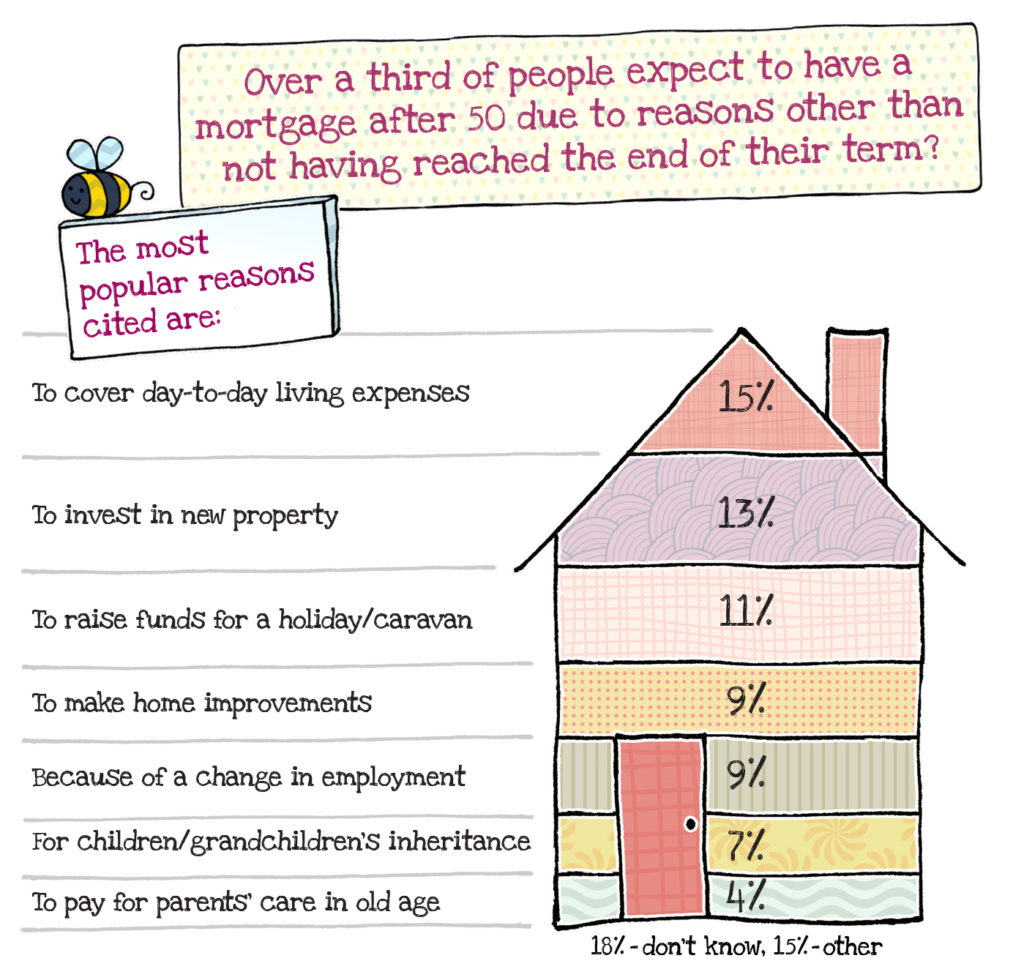
Research from Ipswich Building Society identified a number of reasons, the most common reasons being to cover day-to-day living expenses (15),  the need to invest in a new property (13%), holiday (11%), or to extend or make changes to a current home (9%).

Making house improvements can be a very rational spending decision as maybe you love your house but it needs significant building work to be a comfortable place to live. Heating and energy efficiency becomes more important in later life as older people are more sensitive to the cold.

Another reality of getting older may be changes in employment status/career, the reason given by 9% of survey respondents for why they need a mortgage in later life,  and there can be expenses outside of your control such as the expense of looking after parents in old age (4%).

If you do feel you need to take out a mortgage in later life (age 50 onwards), then you are not alone, with one in ten survey respondents anticipating being over 70 when they become mortgage free.

This number is likely to increase in the years ahead as younger generations are buying their first property later in life than previous generations and, due to higher house prices, mortgage terms are increasing above the traditional 25 year term.

What are the options available?

For those over 50 looking to take out a mortgage in later life there are four main options to consider:

A Traditional Mortgage

This may be the first port of call with both ‘capital & interest repayment’ and ‘interest only’ (assuming a repayment vehicle is in place) variants.

A traditional mortgage might be the simplest option but  if the repayment term is longer than a traditional retirement age then some lenders might be hesitant to agree to the mortgage, or you may be forced to delay retirement.

If you do require a mortgage that extends past age 65, you should search for a provider who looks at all sources of income and assets when addressing affordability, not just earned income.

This search might lead to you seeking the second option, a later life mortgage:

Later Life Mortgage

Some mortgage providers will now take pension income into account as part of their affordability assessments though not every provider will take into account 100% of income from pensions, though Ipswich Building Society will do this.

This is useful to those wishing to take out a mortgage that will extend over the date when they stop receiving earned income, as long as there is sufficient pension assets or income to draw upon to keep up with mortgage repayments. If your total income is not sufficient to cover the full repayment of what you need to borrow, the next option might be the solution.

Retirement Interest Only (RIO) Mortgage

This is a way of extracting the capital tied up within a property and paying back only the interest on the ongoing loan. This could be useful if you have only a small income,  wish to stay in your home but need to take out a mortgage to make improvements to the house or require monies for other spending priorities.

If you have sufficient income to pay the ongoing interest, this can be a good approach as you still own your home and can benefit from any appreciation.

RIO borrowers can remain in their home until a significant life event such as a move into long-term care or death of the last remaining borrower, if a joint mortgage is held.

This option should not be confused with a lifetime mortgage which is a loan that is not repaid in your lifetime, but rather the interest compounds over time and eats into the equity value of your home, finally being repaid upon death.

Equity Release

Different to a mortgage, this involves selling a proportion of your property whilst remaining to live there.

This can be helpful for those who need to release some money from their property but do not want to sell up. Whilst this might seem appealing, it is potentially very expensive, especially if house values go up as they have tended to do over time, and can significantly reduce the value of your estate.

For some this is a price they are willing to pay to stay in their own homes, but if you are considering this option, financial advice is recommended to ensure the full consequences are understood.

Making the right decision

Ultimately, if you are considering a mortgage in later life, it is now more possible to be approved for one than it has been in recent years, though you should understand the consequences of doing so, depending on the approach taken.

Many considering a mortgage in later life will already have a property but may wish to use some of the value of the home as collateral to receive the necessary cash for their needs.

Anyone requiring clarity about later life borrowing should seek the advice of an independent financial adviser who has expertise and qualifications in this market.

This post was sponsored by Ipswich Building Society

Ipswich Building Society has approximately 65,000 members and currently has over 80,000 savings accounts and over 5,000 mortgage accounts. There are nine branches across Suffolk in Aldeburgh, Saxmundham, Halesworth, Woodbridge, Ipswich Town Centre, Ravenswood Ipswich, Hadleigh, Haverhill and Sudbury. The Society also has 2 agencies in Suffolk.

80% of the Society’s members live in the East of England with the remainder living across the UK. Ipswich Building Society was established in 1849. See www.ibs.co.uk


{ 0 comments }